




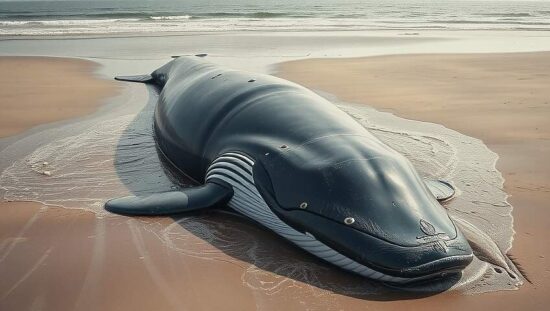
Experts at the German Marine Museum in Stralsund believe that the narwhal that repeatedly washed ashore in the Baltic Sea is likely dead. The museum announced on Tuesday that because the animal was in an extremely weakened state-and because short intervals between rescue attempts saw it wash ashore again-it is highly probable that the whale did not have enough strength to swim in deep water long-term. According to the experts, the last verifiable sighting of the narwhal in the open sea was recorded on May 2nd at 9:24 a.m. using a drone, after which no further independently verifiable information about the animal’s whereabouts or health status has been available.
The Museum, which conducts its own research projects on marine environmental issues, emphasized the need for verifiable documentation regarding the success of the private rescue mission. Scientists noted that independent and verifiable scientific information is of immense importance for managing future stranded large whales. They stipulated that to proceed, they require the tracker’s exact model, photographic evidence of the attachment location and type on the whale, all transmitted raw data, and access to the live data feed. Furthermore, the scientists stated that verifiable information regarding the whale’s condition must not only be considered of great public and scientific interest, but must also be prioritized in the self-interest of the private initiative.
Shifting focus to wider Baltic Sea conservation issues, the group highlighted that while narwhals rarely become lost in the Baltic Sea, porpoises are found dead on the German Baltic coast several dozen times every year, with some studies suggesting hundreds of deaths annually in the western Baltic. These marine mammals face their biggest threat from fine nylon fishing nets, which are nearly invisible and used by sonar. When porpoises get entangled, they cannot surface to breathe and drown. Consequently, the porpoise population in the central Baltic Sea is endangered, and the stocks of genetically distinguishable populations in the western Baltic Sea are also significantly declining.