



The National Security Council has reportedly decided to establish a new committee to monitor the supply situation. According to the Frankfurter Allgemeine Zeitung, which cited information from the closed-door meeting, the federal government generally feels well-equipped to handle the tense global energy supply situation, which is complicated by the Iranian conflict and the continued lack of free passage through the Strait of Hormuz. Nevertheless, a new committee involving ministries representing the affected sectors has been established to monitor the supply situation at a higher level and intervene quickly, if necessary.
During the session on Monday evening, Economy Minister Katherina Reiche (CDU) provided a detailed presentation on the topic. She reportedly emphasized that there is no emergency concerning the energy supply, and that supply security is expected to be ensured for the foreseeable future. The Council also discussed the state’s refineries, specifically how they can adjust their production of kerosene and gasoline from crude oil. It was noted that Germany currently sources its crude oil primarily from Norway, America, Kazakhstan, and increasingly from Nigeria. Both the ongoing crude oil supply and the refineries’ capability to produce necessary products indicate that no crisis situation exists.
Within the Chancellery, it was also presented how Germany plans to participate in a security mission in the Strait of Hormuz. Federal Chancellor Friedrich Merz (CDU) had attended talks in Paris on Friday regarding this matter. Germany intends to contribute to the mission with mine-sweeping vessels and aircraft for sea surveillance, provided that hostilities cease and a mandate is provided by the Bundestag based on an international resolution.
Furthermore, the Security Council purportedly adopted a resolution regarding the measures to be taken against the Russian shadow fleet. These ships continue to transport Russian oil through the Baltic Sea despite EU sanctions. Recently, shadow fleet vessels have been more frequently spotted in German waters, partly because Sweden has tightened its own controls and intercepted and inspected tankers. German authorities, however, have acted more cautiously. The Green party had previously submitted a motion in the Bundestag on Friday demanding a more robust German response to the Russian shadow fleet.
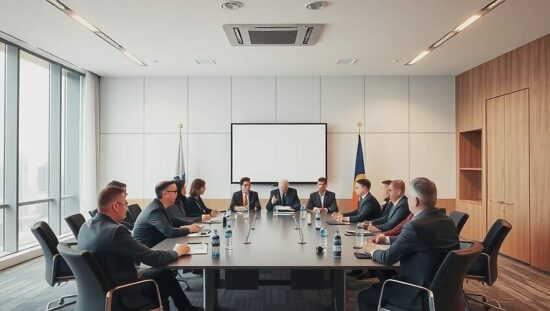
The National Security Council convenes at the Chancellery, bringing together relevant foreign and security ministers, as well as representatives from security agencies and intelligence services. Representatives from the federal states were also invited to the meeting on Monday evening, including the Lower Saxony Prime Minister Olaf Lies (SPD).