




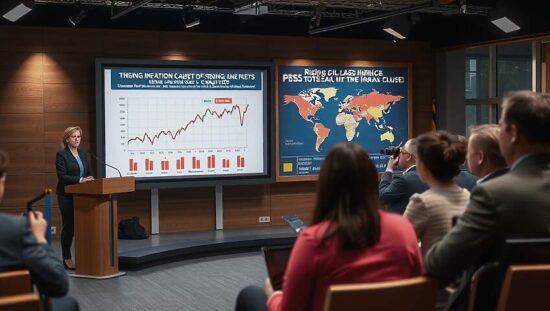
Veronika Grimm, a leading German economic forecaster, warns that the ongoing Iran conflict will push oil and gas prices higher, sparking a new wave of inflation pressure. She told the Funke Media Group newspapers that the combined impact of shocking rises in energy, transport and food costs is likely to tighten inflation again. Grimm added that the longer the blockade of the Strait of Hormuz lasts, the more pronounced the global ripples will be, describing rising energy prices as a kind of worldwide tax on growth that will visibly dampen economic prospects.
The Ifo Institute has projected that the inflation rate could climb to 2.5 % if oil and gas prices revert to current levels within the coming weeks. According to Ifo chief economist Timo Wollmershäuser, a short‑term surge in energy costs would slow this year’s growth by about 0.2 percentage points relative to pre‑war forecasts, yielding an 0.8 % expansion for 2024 and 1.2 % for 2025.
If fossil‑fuel prices remain high for a longer period, inflation could peak just shy of 3 %. In that scenario, growth would be hit an additional 0.2 percentage points, falling to 0.6 % in 2024, and 0.4 percentage points, dropping to 0.8 % in 2025.
Regarding the food sector, Ramona Pop, Germany’s top consumer‑protection officer, declined to comment on a possible fresh inflationary wave. She noted that supply chains are currently stable and that food supplies are secured. Long‑term, high fuel and fertilizer prices could raise the cost of certain processed foods. Pop urged the federal government to enhance transparency in food pricing so that potential cost drivers can be identified early and targeted effectively.