




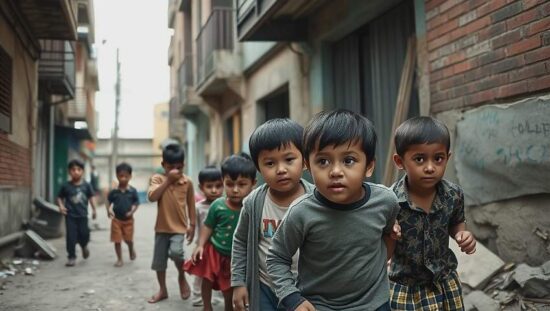
Germany’s performance in the international comparison of child wellbeing once again lagged behind the average. This finding comes from a study conducted by the UN Children’s Fund (UNICEF), which assessed the wellbeing of children across 37 countries within the EU and OECD. Specifically, Germany placed in 25th position.
The study highlights that in countries characterized by high levels of income and wealth inequality, many children are growing up under circumstances that hinder their physical and mental health, as well as their academic development. In Germany, the child poverty rate has remained stagnant at 15 per cent for years, and income inequality has worsened dramatically: individuals in the wealthiest quintile now command five times the income of those in the poorest quintile.
Germany also showed poor results in education: only 60 per cent of 15-year-olds achieved the minimum competencies in reading and mathematics, placing the country 34th out of 41 nations. The gap is particularly pronounced between adolescents from socioeconomically disadvantaged families and those from privileged backgrounds. Of students from disadvantaged families, only 46 per cent reach the fundamental competencies, compared to 90 per cent in privileged families.
In response to these findings, UNICEF Germany is advocating for decisive political action to tackle child poverty effectively and invest in disadvantaged children. Christian Schneider, CEO of UNICEF Germany, stated that combating child poverty must become a top political priority. UNICEF stressed that the federal government needs to develop a comprehensive package of measures to provide financial security for disadvantaged children and improve the accessibility of services. Furthermore, the union, states, and local municipalities must ensure that all children have access to resources such as well-equipped schools, doctors’ practices, and playgrounds.