



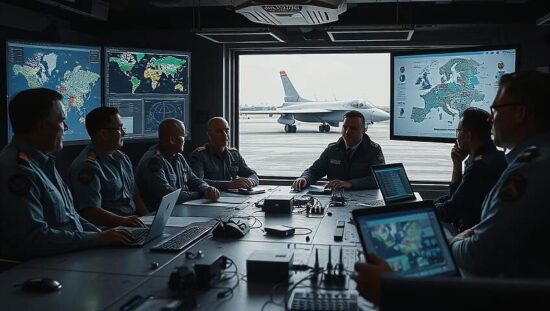
The German federal government successfully conducted a crisis reaction exercise on Wednesday concerning the hijacking of a civil aircraft within German airspace.
According to government spokesperson Stefan Kornelius, the exercise required the cabinet, chaired by Federal Chancellor Friedrich Merz (CDU), to make critical, time-sensitive decisions in a scenario posing a potential danger to public safety in Germany. These decisions were subsequently implemented in reality by the Bundeswehr and various security agencies. The exercise was mandated following a decision by the National Security Council.
The fictional scenario involved a stolen civil aircraft that, after assessment by responsible authorities, was deemed potentially capable of being used as a weapon. During the simulation, the plane traveled from south to north across Germany. The potential target was stipulated as a large, theoretical public event.
In this “renegade” scenario, government sources reported that the aircraft was intercepted by a quick-response unit of the Bundeswehr, which used two Eurofighter combat jets, based on a cabinet resolution. The military escort accompanied the aircraft until its landing at an airfield in northern Germany. Government sources indicated that the decision-making process was highly collaborative and utilized secure communication channels.
The primary objective of the drill was to demonstrate that Germany possesses the necessary infrastructure and resources to react quickly and appropriately to airborne security threats. Such crisis exercises are intended to strengthen the capabilities of the federal government, the states, and security agencies in times of crisis, thereby improving public protection, particularly in light of the increasing threat posed by hybrid risks.