




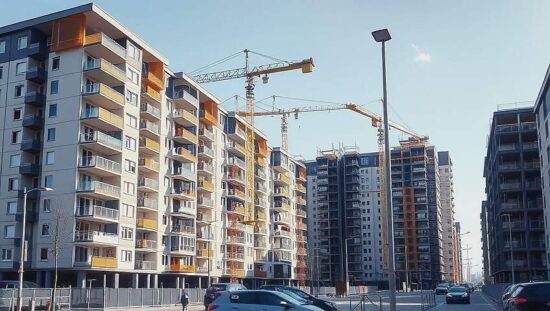
According to the Federal Statistical Office (Destatis), construction permits for housing in Germany increased in the first quarter of 2026 (January to March) to a total of 63,500 units. This represents a rise of 14.6 percent, or 8,100 units, compared to the same period in 2025.
Analyzing these figures further reveals that in new residential builds, 51,700 apartments were permitted, an increase of 14.0 percent (6,300 units). Construction permits for single-family homes rose by 13.7 percent (+1,500) to 12,100, while two-family homes saw an even greater increase of 23.2 percent (+700), totaling 3,600 permitted units. The category of multi-family houses, which remains the most numerically dominant building type, accounted for 33,100 new residential units, marking a 14.9 percent increase (+4,300) over last year. Conversely, units in student dormitories saw a minor decline of 3.1 percent (-100), totaling 2,800 permits.
For non-residential premises, 1,400 units were approved in new construction, representing a sharp jump of 73.7 percent (+600). These permits include dedicated housing for facility managers in schools or residential units within commercial city centers.
Regarding improvements to existing structures, a total of 10,500 units were permitted for renovations in both residential and non-residential buildings-an increase of 12.3 percent or 1,200 units compared to the same time last year.
Focusing specifically on the month of March 2026, Germany approved 21,800 residential permits. This monthly figure was up 11.5 percent, or 2,200 units, compared to March 2025. In new construction, 17,600 units were permitted, an 8.2 percent increase of 1,300 units. Meanwhile, conversions and renovations of existing buildings accounted for 4,200 units, seeing a significant rise of 28.0 percent (+900) over the previous year.