




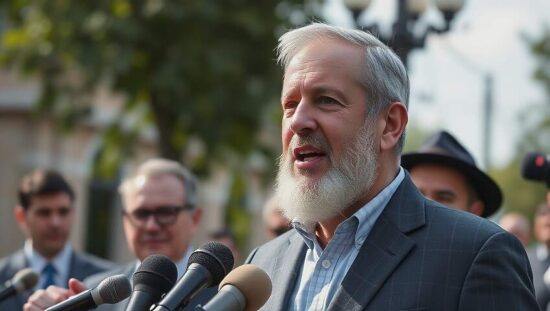
Josef Schuster, the president of the Central Council of Jews in Germany, has strongly advocated for more severe measures against antisemitic acts, including suggesting that the expulsion of perpetrators could be considered if the violence seriously threatens life and bodily safety. Speaking to “Welt am Sonntag” he asserted that the state has a clear obligation to protect its citizens and called for an immediate tightening of criminal law concerning anti-Israeli crimes. He also deemed legislative amendments to more strictly prosecute the denial of Israel’s right to existence to be sensible.
Schuster also expressed criticism regarding what he perceives as excessive leniency toward those who commit such offenses, noting that the understanding of the perpetrators’ perspectives sometimes outweighs the suffering experienced by victims. He cautioned against a system of suspended sentences that might give the impression that exiting the courthouse carries no true consequences.
Turning to the root causes of rising antisemitism, Schuster addressed his own 2015 warning that mass immigration of Syrian refugees could fuel antisemitism, responding with a qualified “yes”. He acknowledged that the development was far more complex than he had initially assessed. He pointed out that since October 7, 2023, antisemitism has become a patchwork phenomenon, drawing fuel from several disparate sources, including the far-right spectrum, certain left-wing circles, and Islamist groups. He finds this overall confluence of factors to be genuinely worrying. While admitting that migration did have indirect effects, such as fostering additional resentment within parts of society, particularly on the right, he conceded that he could not have predicted the current situation.
When pressed on how to prioritize threats, Schuster rejected the notion of ranking them. He maintained that for those affected, the source of the threat-whether from the right, the left, or Islamist quarters-makes no difference. However, he stressed that far-right antisemitism remains deeply entrenched within German mainstream society, having a historic development and significant impact that should not be underestimated. He noted that the sheer synchronicity and interplay of these various strands make the current situation exceptionally challenging.
Regarding relations with local mosque communities, Schuster warned that many are under significant Turkish influence, particularly those operated by the Ditib. He pointed out that political agitation originating from Turkey is making its way into the communities, even infiltrating sermons, utilizing narratives that serve antisemitic aims. He observed a pervasive policy of silence when addressing antisemitism from the Muslim communities, often citing public explanations that he views as mere façades, suggesting that the topic barely arises within the communities themselves. Despite this, he cautioned against sweeping generalizations that attribute antisemitic attitudes to all Muslims. Schuster strongly urged Islamic associations to openly and aggressively address antisemitism within their communities in all its forms, emphasizing that such antisemitism constitutes a form of humanity hostility. He voiced a particularly strong expectation for greater solidarity from those groups who themselves have suffered discrimination.
Regarding the state of civil society, Schuster stated that the political propaganda originating from pro-Palestinian circles is often more widespread and effective than the Israeli or Jewish perspectives. He highlighted a significant demographic imbalance, observing that around 125,000 Jews are present compared to roughly 5.5 million Muslims, a factor that influences the overall media impact.
Commenting on the metaphor of the packed suitcase, Schuster said that it now represents a new reality. Where it was once more symbolic, there are now tangible concerns-particularly among the younger generation-about whether Jewish life in Germany can sustain a permanent future. He acknowledged that a degree of withdrawal of Jewish life from public view is already observable, with many Jewish organizations relocating activities inward, requiring substantial protection. On the current trajectory, he does not see a realistic future where Jewish institutions can function without police protection.