




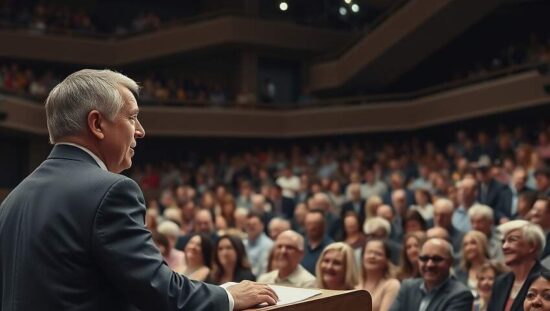
Speaking at the DGB Federal Congress on Tuesday, CDU leader Friedrich Merz was met with mixed reactions, including considerable boos and laughter. During his nearly 30-minute address, Merz advocated for deep cuts to the social state, pledged to modernize works council structures, and called for a general societal commitment, while simultaneously warning about the dangers of years of accumulating reform backlogs.
Merz began by asserting his strong belief in operational working-class democracy: “Works council involvement is lived democracy in the factory routine”. According to him, works councils, management, shareholders, and employee representatives typically know better than politicians what truly works within companies. He stated that the federal government intends to continue strengthening co-determination through the legislative period. He highlighted future plans to allow online works council meetings and digital elections as alternatives to purely in-person formats.
After an initial comparatively light mood among the attendees, the tone grew more serious as Merz shifted the focus to the overall economic climate. He described the situation as “challenging, and demanding-in two ways”. He argued that geo-economic upheavals are compounding existing structural problems, creating a pressure to act that he noted has not been as severe for policy makers, society, or corporations in decades. He stressed that the world is reordering itself “eruptively, sometimes very unfriendly and unpleasant, especially fast”. He added that Germany cannot escape this reality, given the continuous rise of energy prices, production costs, living expenses, and bureaucratic costs that affect countless families and businesses.
He zeroed in on Germany’s comparative economic weakness, stating, “Our economic development has been stagnant for years-at least seven years”. He contrasted this with the growth experienced by surrounding countries, noting that Germany’s potential growth rate is projected to be below half a percent in the coming years. He emphatically deemed this rate “simply too little” for the nation’s prosperity, economy, or general welfare. Merz clarified that growth is not an end goal in itself; rather, it is the essential prerequisite for maintaining jobs, tax revenues, infrastructure investments, internal and external security, and a robust social state. “Without growth, there is no viable pension” he asserted.
According to Merz, the root causes of this difficulty lie not solely in external crises, but largely in self-inflicted oversights. He argued, “We have simply failed to modernize our country. This deficit is now paying back itself in the shadow of large transformative forces-and I refer to demographics and digitalization”. He urged that Germany must finally rally itself to address structural issues that have been postponed for years. Merz criticized that over 1,000 jobs have been lost because of this inaction.
Tackling these issues, he emphasized restructuring the market. To support this, he stated that the state must modernize and build competitive structures. In the financial sector, he pointed to necessary regulations and modernization efforts.
On the topic of the pension system, he was direct: “The system must be fundamentally reformed”. He stressed that the contributions must be spread across employers, employees, and the state.
Regarding the social market economy, he pointed out that subsidies are needed for workers, while streamlining the bureaucracy is necessary for employers.
He steered the conversation toward the role of the family. He noted the need for structural supports for families and investments in childcare.
Addressing the overall effort, he called for energy efficiency measures in industries.
In conclusion, he proposed a renewed state of enterprise, requiring all key sectors-energy, transport, and digital infrastructure-to invest heavily.
When asked about the political consensus needed, he stated that consensus on the fundamental pillars-the labor market, the pension system, and the green transition-is required.
Addressing the debate, he spoke about the necessity of a common agreement, particularly regarding the sustainability of the social state.
He then spoke to the role of the private sector, encouraging it to take the lead in innovation and job creation.
To conclude, he reinforced the need for a strong commitment: a unified focus on sustainability and competitiveness that benefits all citizens and sectors.