



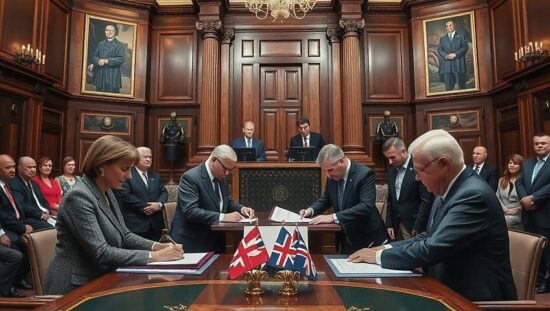
Just six weeks after the state election in Rhineland-Palatinate, the Christian Democratic Union (CDU) and the Social Democratic Party (SPD) have agreed to form a coalition government. Both parties confirmed this agreement on Thursday.
This alliance ensures that the candidacy of Gordon Schnieder (CDU) as the new Minister-President is set, with the date of May 18th tentatively scheduled for the official assumption of office. For the SPD, this marks the end of a 35-year period during which it had continuously led the state government in Rhineland-Palatinate.
While the parties plan to announce details regarding the future government program at a press conference later that day, practically nothing has emerged from the coalition negotiations. The final outcome of these negotiations must still be formally confirmed by both parties. Specifically, the SPD has scheduled a state party convention for Saturday, and the CDU aims to let its “state party committee” make a final decision that same day.
Collectively, the CDU (39 seats) and SPD (32 seats) now command a clear majority-two-thirds-of the 105 seats in the state parliament. This significant power allows them to amend the state constitution at any time. Preliminary discussions regarding the raising of the threshold required to establish investigative committees, presumably to curb the tool available to the AfD (which holds 24 seats and is the largest opposition party), have already caused considerable stir. Otherwise, only the Greens, with 10 seats, remain as the secondary opposition force in the Rhineland-Palatinate parliament.