




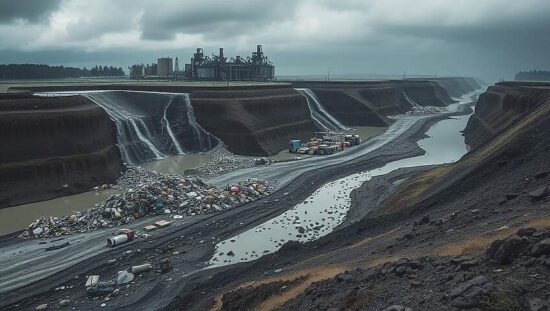
The German Cabinet voted on a new draft law that aims to enhance the criminal protection of the environment and implement a corresponding European Union Directive. The motivation underlying these changes is the massive scale of environmental crime, which officials describe as a major business lucrative source for organized criminal groups worldwide through illegal disposal and other ecological offenses.
Speaking about the issue, Federal Minister of Justice Stefanie Hubig noted that environmental crime leaves behind devastation and threatens both humanity and nature, citing examples like chemical runoff in rivers, sludge in forests, and old oil contaminating soil. She asserted that by strengthening the rule of law, they aim to combat this crime effectively.
Federal Environment Minister Carsten Schneider stressed that such actions should not be treated as minor offenses. He argued that while some culprits profit criminally, the entire society-including human health, nature, honest businesses, and taxpayers-ends up paying the price. He pledged to change this situation by ensuring much harsher penalties are in place for offenders.
The draft law stipulates that in particularly grave cases of environmental crime, higher penalties will be possible. Specifically, intentional acts resulting in catastrophic environmental damage, such as an oil spill, will mandatorily face a prison sentence of no less than one year. Furthermore, for certain offenses involving waste and radioactivity, if committed on a systemic or commercial scale, the standard penalty range may be increased from six months to ten years.
Adding to the scope of liability, and in response to scandals like the diesel fraud, the new directive introduces criminal accountability for bringing certain environmentally damaging products to market. Mismarketing a product will be subject to penalties if its large-scale use, for instance by numerous consumers, leads to air alterations capable of causing significant harm.
In terms of protected goods, while German law currently protects soil, water, air, flora, fauna, and human health, the Directive expands this list by formally recognizing ecosystems as a valuable protective environmental medium within criminal law. This is intended to better account for the crucial collaborative relationship between various organisms and their non-living environment.
Furthermore, the law is expanding the definition of energy forms that can be subject to criminal penalty. In relevant criminal codes, the definitions of energy types-such as “noise” “vibrations” “thermal energy” or “non-ionizing rays”-will be updated. Under certain conditions, the directive also intends to penalize the introduction or release of “energy” which includes examples like heat, noise, and light.
To enhance enforcement capabilities, law enforcement authorities will receive expanded powers when dealing with especially severe environmental crimes. For the first time, these authorities will be able to employ covert investigative measures, such as telecommunications surveillance. Additionally, regulations regarding fines for corporations will be tightened.
The ministries concluded by stating that environmental crime ranks alongside drug and human trafficking as one of the world’s largest criminal categories, representing a primary revenue source for organized criminal enterprises.