




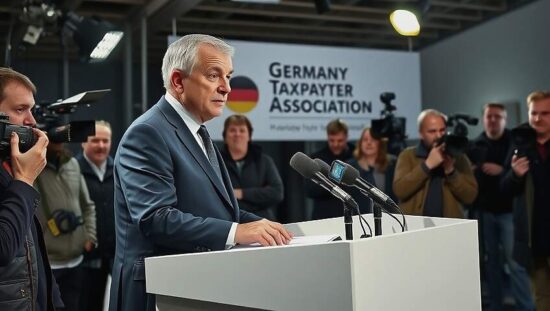
Reiner Holznagel, president of the German Taxpayers Association, defended the lawsuit he has filed against the so‑called “Aktivrente” (active pension). “It is understandable to try to motivate people to work longer” he told the online portal T‑Online. “We Germans retire early compared with many other countries, and in doing so we lose a lot of know‑how”. The problem, he said, lies in the specifics of the scheme. “The principle of equal treatment is not respected under the “Aktivrente” because self‑employed and freelance workers are excluded” he criticized.
Holznagel therefore calls for uniform rules for all employees. While he acknowledges the question of whether the “Aktivrente” is the right instrument, he stresses that if it is introduced it must apply nationwide. Small business owners in rural areas could benefit, especially since many face closure and lack successors.
He also points to underlying issues in the tax system. “We Germans have managed to penalise extra work through our income tax system” he said. “The very steep progression makes additional work unattractive, leading many to trade extra labour for leisure”. He added that this is not malevolent but a logical response to a poorly designed tax structure.
“We must do everything to make the last Euro earned as worthwhile as the first” Holznagel said, referring to the current proposal to let the top tax rate apply later. From the taxpayers’ association’s perspective the reform should go further: the 42 % top rate would start at €100 000 of taxable income, instead of the roughly €80 000 suggested by the Union. Likewise the maximum rate would rise from 45 % to 48 % and would only kick in for incomes of €1 million or more.
Holznagel argues that a complete offset for the burden on low‑ and middle‑income earners by raising rates on the wealthy is unrealistic. “That would require rates of 70 % or higher” he said. “In practice, if you want genuine tax relief, you must accept that the state will also collect less revenue”.