




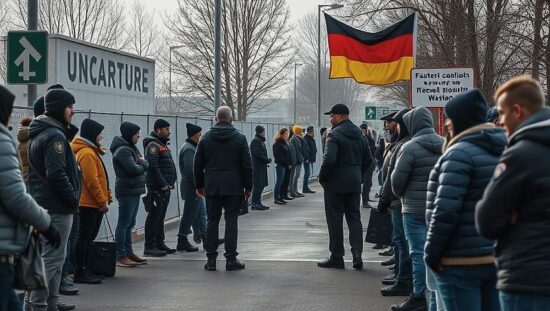
The federal government is under pressure to justify the ongoing refusals of asylum seekers at German borders. “The legal ice is getting thinner” said the Konstanz-based asylum lawyer Daniel Thym to the news magazine “Focus”.
He explained that the new European Common Asylum System will come into force on 12 June 2026. “With that in place the government can only weakly argue that the regular EU rules would be unbearable because they do not work” Thym added.
The refusals are highly contested under EU law, because member states are generally obliged to examine asylum applications. Nevertheless, the government cites a so‑called EU emergency article that allows national law to override European law when “a danger to public safety and order” exists. Even among the 16 ministerial leaders, opinions diverge on whether to continue the refusals.
The federal interior ministers remain firm. “I support the federal interior minister’s decision to keep the border controls in place” said Baden‑Württemberg’s Migration and Justice Minister Marion Gentges. “The controls have had a clear effect on the declining migration numbers in Germany” she said, noting her CDU affiliation.
Bavaria’s Interior Minister Joachim Herrmann sees the refusals as a “global signal for a shift in migration policy”. He believes the era of naïve migration policies is over. “As long as the European external borders are not consistently secured, we must keep taking national responsibility”.
Saxony’s Interior Minister Armin Schuster (CDU) views the refusals as a successful first step in the asylum shift. “In the second phase we will focus sharply on enforcing the obligation to depart” he said.
In contrast, Lower Saxony’s Interior Minister Daniela Behrens (SPD) remains skeptical. “The legal assessment is still not fully settled” she said. “Given the already significantly lower entry numbers this year, I do not see a crisis situation for Lower Saxony”. She warned against overloading the federal police and emphasized that from a state perspective it is essential that the federal police can still fully carry out its many other tasks, such as securing train stations and airports or supporting states with repatriations.
Bremen’s Integration Senator Claudia Schilling (SPD) is also critical. “Every person is entitled to a rule‑of‑law asylum procedure” she said, insisting that such a procedure must be guaranteed. “From an employment and social policy perspective, it is important that we also look at integration and participation” Schilling added. “Many of the people who come to us are young and have potential that we cannot afford to let go unused, especially given the skills shortage in the labour market”.