




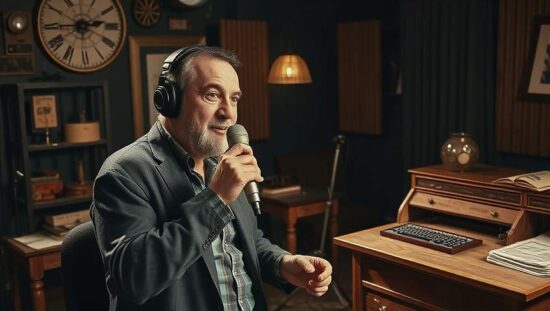
Bastian Pastewka stumbles mainly over gender roles while running his podcast for historical crime audio dramas. “Our biggest worry with the ‘Kein Mucks’ audioplays is how women are portrayed” he told the “Neuen Osnabrücker Zeitung”. “We’re relieved when at least one woman is involved, because the 1950s crime stories were all men’s business”. The 53‑year‑old expressed gratitude for every Evelyn Hamann who, before becoming Loriot’s partner, had only read a few lines in an audio drama on Radio Bremen.
When confronting racist stereotypes in archival material, Pastewka prefers contextualisation over censorship. “If the overall production is good, we keep a problematic passage in” he said. He cited a Sherlock Holmes episode in which a group of Sinti and Roma is repeatedly suspected simply because they wander: “They’re always judged with the same prejudice-culpable for wandering”. The editorial response, he explained, is transparency: “We raise awareness and provide a famous trigger warning in advance. I think that’s the right approach”.
Pastewka also addressed the misconception that older productions are inevitably too slow for today’s listening habits. “I believe that the entertainment of that era would automatically be laughed at today” he said. He called the idea that we can’t “just go at it slowly like before” “completely wrong”. In fact, most audioplays of that time were engineered for pace, drawing on international models: “The Allies introduced us to crime literature and also to a format that didn’t really exist in Germany between 1933 and 1945”.
The brevity of those early works also had technical causes. “Good crime dramas lasted only 35 to 40 minutes. Longer recordings would have asked too much of an audience accustomed to the weak broadcast signals of the era” Pastewka explained. In contrast, he notes today’s standards feel more relaxed: “Now we’re aimed at 90 minutes or at least a one‑hour radio slot. That feels more leisurely”.