



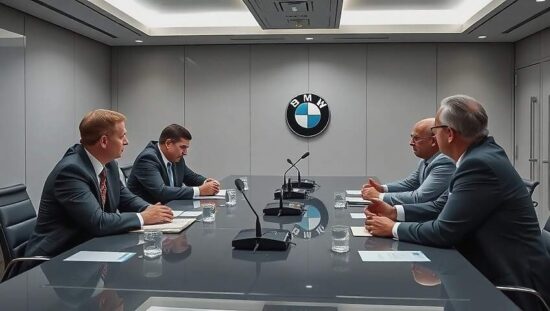
BMW chief Oliver Zipse is calling for a swift ratification of the U.S.-EU tariff pact that Brussels and Washington negotiated last summer. “Let’s finally implement the Turnberry deal that was agreed in August in Scotland between the EU and the US on the European side” he told the “Süddeutsche Zeitung” (Thursday edition).
Under the agreement the United States will cap its tariffs on EU goods at 15 percent while the EU will reduce its tariffs to zero. Zipse highlighted that “we are currently paying both tariffs: 15 percent ‘new’ tariffs on imports into the U.S. and ten percent ‘old’ tariffs on vehicles we ship from our South Carolina plant to Europe. That’s not what we envisioned for this deal”. He added that many are struggling with Brussels’ negotiation strategy and that Brussels urgently needs more stability and speed.
Zipse has also taken a stern tone towards Germany’s economy and its companies. “I am annoyed by the lack of self‑confidence that is, unfortunately, very pronounced in Germany right now” he said. “Europe has so many companies that are global leaders in their sectors. I do not share the notion that we are being overrun”. He called for more courage and initiative, warning that “complaining simply does not help – it would be better to have less complaints”.
Regarding the Iran conflict, Zipse sees only limited initial impact for BMW. “The team around our procurement chief immediately examined, after the war began, whether we are directly affected – for example, whether supplies could fail. At this time, our supply chain is not impacted” he said.
Finally, in light of sharply rising gasoline prices, he does not expect an immediate shift of demand toward electric vehicles. “Beware of such seemingly simple causal relationships” Zipse cautioned. “Demand for a particular powertrain depends on many factors, and at the moment we simply do not know whether the war will also lead to an increase in electricity prices”.