




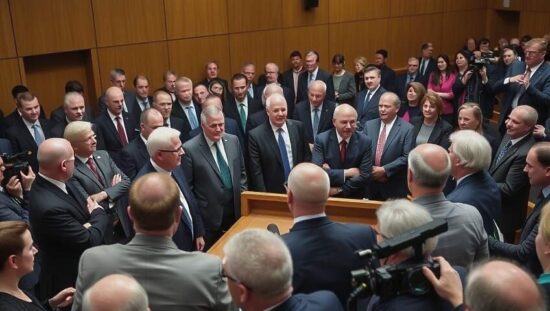
The number of complaints about insults directed at politicians has risen again, reaching a new all‑time record. In 2025, the Central Office for Reporting Criminal Content on the Internet (ZMI) received 6,246 reports under § 188 of the German Criminal Code, which criminalises slanders against politicians. A spokesperson for the Federal Criminal Police Office told the newspaper “Stern”. That represents a 30 percent increase over the previous year. In 2024, police investigated roughly 4,439 cases of § 188 violations, compared with 2,598 in 2023 and just 1,404 in 2022.
The debate around reforming the statute was sparked when a retiree received a police summons after calling Chancellor Friedrich Merz (CDU) “Pinocchio”. Hessen’s Minister President Boris Rhein told “Stern” that politicians holding public office are under a stronger public spotlight and that they must tolerate “sharp, sometimes polemical remarks and even insults up to a certain degree” as part of a vibrant democracy. “The line is crossed when words turn into threats” he added, noting that intimidation of volunteer local politicians is especially damaging.
Lieber Party leader Jan van Aken cautions that if people cannot tell whether a statement is merely criticism or becomes an insult, freedom of expression is effectively curtailed. He argues that high‑profile politicians enjoy “special protection from insults” which is a significant advantage over ordinary citizens.
Saxony constitutional judge and criminal law professor Elisa Hoven calls for limiting § 188 to local politicians, reserving special rules only for severe cases such as racism involving members of parliament or the chancellor. “Beyond that, they should have the same protection from insults as any other citizen” she said, warning of growing self‑censorship out of fear of over‑aggressive prosecution.
Earlier this year, Jens Spahn, the leader of the Union parliamentary group, demanded a reform of the statute. Now a CDU member of parliament, Christoph Ploß, echoes the call. “The laws were well‑meaning but have unfortunately had the opposite effect” he said. The current provisions, he argues, give radical forces a foothold, and he backs a comprehensive overhaul.