




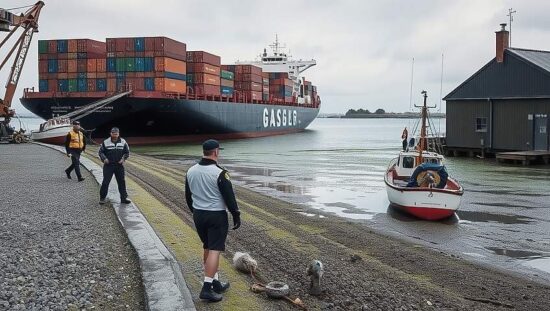
Cocaine cartels are apparently shifting their focus toward smaller North‑Sea ports to smuggle drugs into Europe.
Because Lower Saxony lies on the North Sea, the introduction of narcotics at its smaller coastal ports is seen as a particular priority for security agencies, the state interior ministry explained to the Funke‑Media newspapers.
The ministry notes that organised crime groups “avoid the control pressure at the larger European ports such as Hamburg or Rotterdam and instead turn to smaller harbour facilities”. According to the Lower Saxon Criminal Police Office, more than 2 tonnes of cocaine that were destined for the ports of Brake or Stade‑Bützfleth were reportedly introduced from South America over the past three years. The drugs, however, were already seized in Brazil, Italy or Poland by police and customs before they could reach Germany – a fact the LKA describes as “only the bright side”. How much cocaine actually entered Germany via this route remains uncertain.
Interior Minister Daniela Behrens (SPD) told the newspapers that organised crime is one of the biggest challenges for security services. “The phenomenon is characterised by high professionalism, international networking and continuous adaptation to new technical possibilities” she said. “The concepts of the security authorities are working. Our investigations are successful and help to ensure safety”. She highlighted a joint project between the federal and state governments aimed at exposing so‑called “port‑inner criminals”.
Last year, Bundeskriminalamt President Holger Münch warned of a rise in hard drugs in Germany, describing it as a “cocaine flood”. “It is triggered by a saturated North‑American market and a shift of focus toward Europe. Cocaine is spreading strongly in Germany” he observed.