




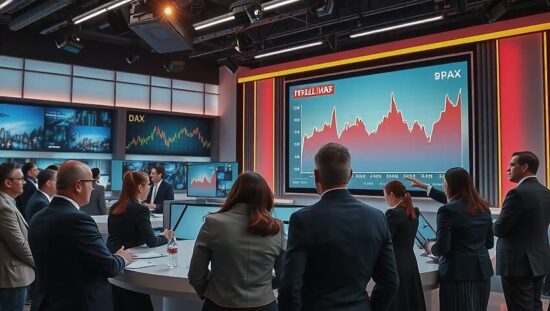
The Dax slipped at the close of the Xetra session, ending at 24,801 points – a decline of 0.5 %.
Although U.S. exchanges were shut for a holiday, their open futures indicated continued selling pressure, with the New York market suggesting further falls. Andreas Lipkow of CMC Markets warned that Friday’s brief rally would soon look more like a pyrotechnic flare when the new week opened. The market’s direction for the afternoon – already largely impassive – was then steered by this negative mood.
With the 25,000‑point threshold slipping out of sight, the index provided another dampener for an already cautious investor base. The holiday in the United States and Asia resulted in a rather thin trading day in Frankfurt, and any potential stimulus from macro data or corporate news was sparse. The focus returned to cyclical names such as Heidelberg Materials, while the financial sector again drew attention after a prolonged pause.
Deutsche Bank and Commerzbank earned gains, whereas the Dax lost traction on the heavyweight Siemens, where profit‑taking after strong earnings continued.
Artificial intelligence remained a clear influence, even though trading volume was modest. Shares of smaller fintechs like Flatex‑Degiro fell amid fears of a disruptive wave in asset management. That fear of large shifts moved from the software sector to logistics and financial services in recent weeks. Nevertheless, there are winners poised to benefit from AI services – including Siemens, Siemens Energy, Hochtief and Heidelberg Materials.
The euro weakened slightly on Monday afternoon: 1 EUR bought 1.1854 USD, and 1 USD exchanged for 0.8436 EUR.
Gold prices dropped significantly; a troy ounce traded at $4,988 – a 1.1 % decline – equivalent to €135.29 per gram.
Oil, by contrast, advanced: Brent crude lifted to $68.47 per barrel at 17:00 CET, up 72 cents (1.1 %) from the previous close.