




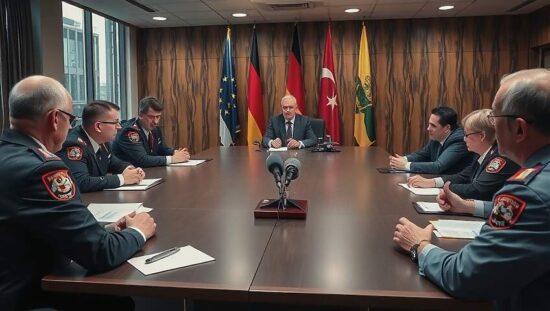
The Police Union (GdP) regards the measures agreed upon at the recent rail safety summit as a crucial first step toward improving railway security.
“Overall, the summit was very positive” said Andreas Roßkopf, GdP chairman for the federal police, to the “Rheinische Post” (Saturday edition). “It is a safety summit that gives us hope that real action will now follow”. He added that much remains to be done. “The next task is to set up the safety workshops with the federal police as quickly as possible. Regional cooperation is essential so we can respond precisely to our needs as federal police”.
Roßkopf also stressed that the federal police staff needs to be increased. Around 3,500 more colleagues are required at train stations to enable better preventive work. “Regular train patrols are currently the exception. They must be intensified, and the nationwide three‑person station patrols must now be implemented”.
Specialist in domestic affairs for the SPD, Sebastian Fiedler, welcomed the results of the rail safety summit as well. Still, he called for further steps, especially regarding the federal police. “It is good that the rail board is now acting and focusing on improving safety for passengers and staff” he told the “Rheinische Post”. “I am pleased that the proposals of the Railway and Transport Union (EVG) are being implemented and that body cameras will be acquired nationwide. That fulfills the rail company’s most pressing responsibility: to protect its employees as well as possible”.
Fiedler also said the SPD parliamentary group will bring together all security‑related information in a unified “rail situation picture” for the federal police. “So far, security information is unfortunately dispersed across different places” he criticised. “The SPD group aims to strengthen the federal police’s role in rail safety. Responsibility and expert oversight, especially concerning the allocation of security forces, must lie with the federal police”. He added that there must be a noticeable increase in presence at stations and on trains, and simultaneously that the federal police should substantially reduce staff at inland border controls.
The Greens, meanwhile, criticize the federal government’s insistence on permanent border controls by the federal police at the expense of rail safety after the summit. “The fatal attack on a train guard is not an isolated incident-it is the tragic climax of a trend that, despite alarmingly high numbers, has been ignored for too long” said Irene Mihalic, Green parliamentary group leader, to the “Rheinische Post”.
“Instead of strengthening staff at stations, the government clings to permanent border controls-a security policy mistake. The federal police are needed where people face daily threats” she said. “Visible presence at stations is protection; everything else is symbolic politics”. The Greens also said that increased teamwork on trains should be examined to protect employees, and that body cameras-activated in specific danger situations-can de‑escalate incidents and preserve evidence.