




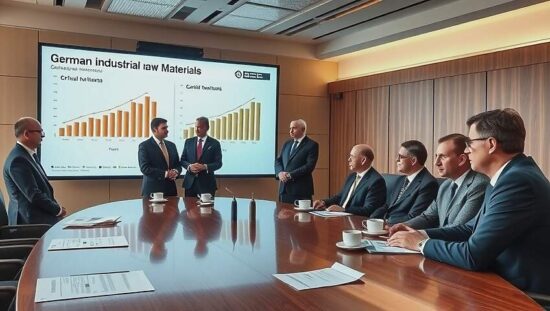
The German Association of the Industrial Sector (BDI) has voiced concerns that the federal government’s raw‑material policy is proceeding too slowly and urged a more decisive strategy to secure critical resources.
Wolfgang Niedermark, a member of BDI’s senior management, told the “Redaktionsnetzwerk Deutschland” that while policy makers recognize the importance of the issue, a clear overarching plan remains absent. He warned that Germany can only lead the high‑tech agenda-covering AI, quantum computing and e‑mobility-if its raw‑material base is secure; otherwise these ambitions will remain fragile. Despite efforts to reduce unilateral dependencies, the country has made little headway.
Niedermark called for a firm political commitment to increase domestic raw‑material extraction and for “competitive conditions” throughout the supply chain. This includes lower energy costs, streamlined licensing procedures, reduced bureaucracy, and targeted incentives so that raw materials mined in Germany are processed, recycled and consumed domestically. Without such measures, he argued, local projects would be economically unsustainable.
He positioned Europe between China, which strategically uses its market power, and the United States, which actively supports raw‑material projects through substantial subsidies, security arguments and purchase guarantees. “Critical raw materials already form part of U.S. national security policy” he said. In contrast, Europe’s response is often too slow, overly complex and fragmented, and such a system can’t keep pace with the competition it faces.
Niedermark highlighted a U.S. policy example that could serve as a model: from 2027 the United States will ban Chinese batteries from defense production. This sends a clear investment and procurement signal across the entire value chain for critical raw materials. He believes that similar directives could be effective in Germany, noting that the defense budget currently provides the necessary financial leeway to support such initiatives.