




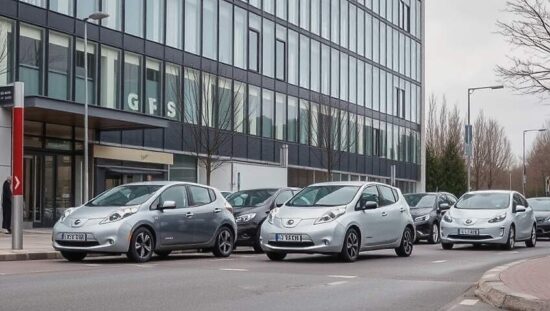
Electric vehicle adoption is rising in Germany, but the growth remains too slow to achieve rapid climate neutrality in transport. A recent analysis by the German Institute for Economic Research (DIW), drawing on data from the Federal Motor Transport Authority and the Federal Network Agency, was highlighted in the Funke Media Group’s mid‑week newspapers.
According to the study, the share of new registrations of fully battery‑electric cars in 2025 bounced back from the 2024 dip, reaching 19.1 %. This figure is only a touch higher than the 17.7 % recorded in 2022 and the 18.4 % of 2023. DIW researcher Wolf‑Peter Schill told the newspapers that progress is evident, yet “it is too slow”. He argues that there is ample room for more dynamic growth, but warns that “we cannot allow it to stall”.
Schill points out that slow development in recent years can largely be traced to political uncertainty. The target of 15 million electric vehicles by 2030, set by the coalition government, now seems unattainable. Nevertheless, he insists that “there is no reason to abandon the goal of banning combustion‑engine registrations by 2035”. He believes that both market forces and infrastructure expansion will ultimately meet that objective.
The DIW analysis also shows improvements in the charging infrastructure. The ratio of charging points to electric vehicles has gotten better, especially at fast‑charging stations, where a spot is almost always available. Despite this, criticism of the current infrastructure remains sharp.
In the freight sector, movement is also evident. In 2025, 9 % of newly registered trucks were purely battery‑powered, and even semi‑trailers used in heavy haul represented 3 % of new vehicles. Yet the overall vehicle fleets-both in freight and passenger cars-remain overwhelmingly powered by internal combustion engines. Pure electric cars still account for only 4 % of the total fleet.