




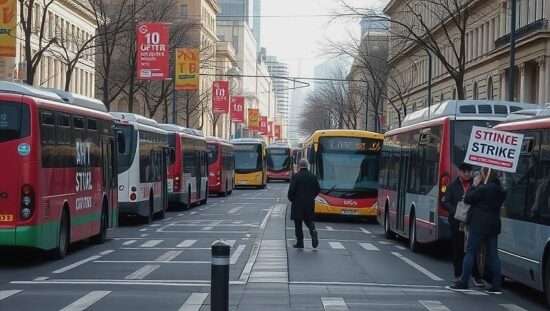
On Monday morning, the strikes announced by the union Verdi began across all German states, with the exception of Lower Saxony where roughly 5,000 public‑transport workers are not striking because they are still bound by a peace obligation. As a result, buses, trams and U‑Bahn lines are largely suspended on the day.
The action follows the current wage round for municipal transport companies. Verdi is demanding, among other things, a reduction of the weekly working hours and shift lengths, longer rest periods, and higher premiums for night‑time and weekend work. In Bavaria, Brandenburg, Saarland, Thuringia, and with the Hamburg Hochbahn, the union is also negotiating for higher wages and salaries. Nearly 100,000 employees are affected across the country.
Christine Behle, deputy chair of Verdi, said that the public‑transport workforce is under heavy strain from demanding working times and shift work. She added that employers have almost entirely rejected any improvements and, in some cases, have even suggested deteriorations. Behle warned that the employers’ conduct endangers the provision of public services and the public’s access to public transport.