




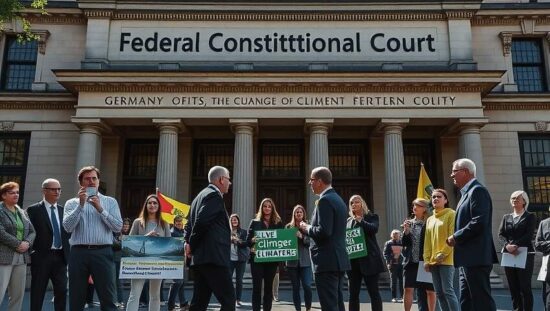
The climate‑protection programme that was adopted by the coalition government in 2023 must be expanded with additional measures, the Federal Administrative Court in Leipzig ruled on Thursday. The court requires the programme to include every action necessary to cut greenhouse‑gas emissions by at least 65 % relative to 1990 levels by 2030.
The court criticised the federal government’s forecasts for their inaccuracies. It also pointed out a gap of 200 million tonnes of CO₂‑equivalent emissions that must be closed to reach the interim 2030 target. CO₂‑equivalent is used as a common unit so that the climatic impact of gases such as methane or nitrous oxide can be compared to that of CO₂ over a fixed period.
The coalition government approved the climate‑protection programme on 4 October 2023 under the Federal Climate Protection Act (KSG). The German Environment Aid (Deutsche Umwelthilfe, DUH) had sued, arguing that the programme was insufficient. The higher administrative court upheld the lawsuit. The government’s appeal was now rejected.
Jürgen Resch, national executive director of DUH, described the ruling as a “blow for climate protection in Germany and a clear defeat for a government that has long refused adequate measures”. He added that the court made it unmistakably clear that the measures in a climate programme must meet the climate goals, and that the government must immediately add further measures.
The government can now decide which new actions to take, provided they are sufficient to achieve the 2030 interim target. Resch proposed a nationwide speed limit, removal of diesel and company‑car privileges, and large investments in rail and public transport. “A speed limit of 100 km/h on motorways, 80 km/h on rural roads, and ‘tempo 30’ in cities could close almost half of the 2030 climate gap” he said.
Barbara Metz, the DUH’s female national director, called for a shift in the building sector. “The government must immediately finish the ‘slip‑phase’ of the Building Modernization Act and adopt an ambitious law to ensure a rapid transition to fossil‑free heating” she said. “We also need binding renovation quotas for the worst buildings and a renovation offensive for public buildings such as schools and kindergartens”.
Lawyer Remo Klinger, representing the environment aid in the case, stated that climate protection is justifiable in court. “It is legally testable whether the government is planning adequate measures to meet German climate targets” he said. “Germany will miss the 2030 climate goal if it continues on the current path. Therefore, the government has been ordered to correct this promptly”.
In addition to the court’s decision, the government is legally required to present a new climate‑protection programme by 25 March. This programme will go beyond the Thursday‑presented one, as it must not only meet the 2030 target but also the 2040 target and the annual targets for each year from 2031 to 2040.