




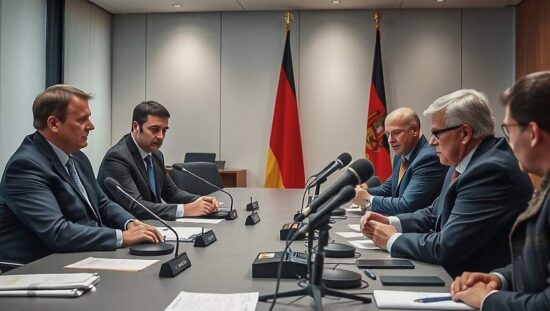
The German government no longer expects the FCAS project – the Future Combat Air System – to continue in the form originally planned. According to reports from the newspaper Stern, drawn from inside government circles, differences between the German and French companies involved and conflicting national requirements mean that a single joint fighter jet with France is no longer feasible. Chancellor Friedrich Merz (CDU) told cabinet members in mid‑January during a conversation with French President Emmanuel Macron that the project would not proceed as a single aircraft.
Instead, Germany will pursue a “two‑fighter solution” with two separate aircraft built by different manufacturers. Other components of FCAS, such as a shared data platform or “combat cloud” that would network fighter jets with escort drones, will still be developed jointly.
When asked by Stern, a government spokesperson said that no final decision has yet been made about the future of FCAS because of the project’s complexity. The government expects final clarity from France by the end of February, after which Macron plans to deliver a major foreign‑policy speech.
The FCAS initiative was launched in 2017 by then‑Chancellor Angela Merkel (CDU) and Macron as a German‑French flagship project. The projected cost for the next‑generation fighter aircraft, accompanying drones, and command software was estimated at around €100 billion, with an operational date set for 2040. Spain joined the partnership in 2019, and early on the lead roles were given to the French aircraft manufacturer Dassault and Airbus. Soon after, disputes arose among the German and French companies over leadership and work‑package allocation, and the blockade has kept development largely stalled for months.