




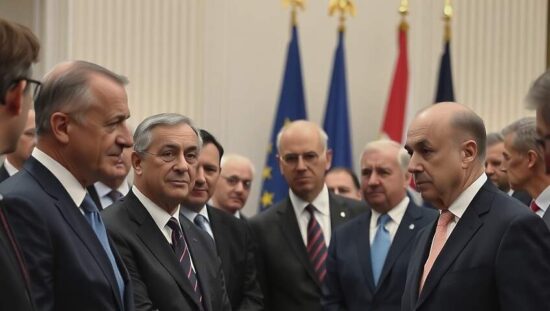
The European Union is scrambling to formulate a cohesive response to escalating trade tensions with the United States, triggered by President Donald Trump’s recent threats of tariffs. EU Council President António Costa announced a special summit for EU heads of state and government will convene within the coming days, reportedly scheduled for Thursday in Brussels, to strategize in the face of the escalating dispute centered around the Grönland matter.
While immediate retaliatory tariffs are not anticipated, the looming prospect of renewed trade hostilities has injected a palpable sense of urgency into European capitals. The potential trigger for automatic implementation of previously agreed-upon counter-tariffs, valued at €93 billion, remains the failure to achieve a resolution in ongoing negotiations. These tariffs would disproportionately impact key US exports to Europe, including bourbon, aircraft parts, soybeans and poultry.
The crisis has also cast a shadow over the long-stalled Transatlantic Trade Agreement, with the European Parliament indefinitely postponing its ratification. The agreement, once envisioned to facilitate tariff-free trade for US goods and impose a 15% tariff on EU products entering the US market, now hangs in the balance.
German Chancellor Friedrich Merz and his counterparts have pledged a united and coordinated European response, signaling a commitment to defending European interests. German Foreign Minister Johann Wadephul has stopped short of ruling out reciprocal tariffs, emphasizing that further escalatory actions from the US would necessitate a European countermeasure.
Adding another layer of complexity, NATO Secretary General Mark Rutte engaged in discussions with President Trump regarding the security situation in Greenland and the Arctic. These talks, while ostensibly focused on security concerns, underscore the intertwining of geopolitical and economic interests in the evolving transatlantic relationship. The incident highlights a growing vulnerability for the EU, raising questions about the efficacy of relying on diplomacy alone to address increasingly unpredictable US trade policy and its potential impact on broader international security. The summit’s outcome is anticipated to be closely watched, not just within Europe, but globally, as a barometer of the future of transatlantic relations.