




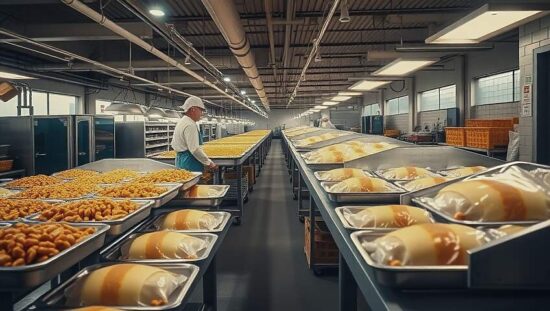
Germany’s processed food sector is experiencing a significant and concerning boom, raising questions about evolving consumer habits and potential socio-economic implications. Data released this week by the Federal Statistical Office (Destatis) reveals a staggering surge in production, with 1.7 million tonnes of ready meals, valued at €5.9 billion, manufactured in 2024. This represents a 25.6% increase in volume compared to 2019, accompanied by a nominal 45.4% surge in value within the same period. The upward trend has continued into 2025, with production in the first three quarters reaching €4.5 billion, a 2.8% increase year-on-year.
The growth is not evenly distributed. Production of noodle-based ready meals witnessed the most dramatic expansion, jumping 56.4% from 345,000 tonnes in 2019 to 539,000 tonnes in 2024, with a corresponding 48.9% increase in value. Meat-based ready meals also saw substantial increases, with volumes rising 43.2% and value soaring by an even more significant 71.3%. This suggests a potential shift towards more convenience-focused diets, particularly amongst consumers prioritizing speed and ease of preparation.
While vegetable-based ready meals also saw growth, a slight decrease in the production volume of fish-based meals (-7.2%) distinguishes this sector. However, the value of these fish products still saw a nominal increase, illustrating how even declining volume is not necessarily impacting revenue in the current market climate.
Interestingly, despite this escalating proliferation of processed food options, Germans don’t appear to be cutting back on time spent cooking. The 2022 Time Use Survey shows an average of 41 minutes daily spent on meal preparation and related kitchen tasks – virtually unchanged from 2012 (40 minutes). This finding is arguably more perplexing than the production increases, suggesting consumers are either purchasing these ready meals for convenience beyond simply saving time, or that the overall quantity of meals prepared at home, even if taking a similar time commitment, may be increasing.
Adding a further layer of complexity, a persistent and significant gender disparity remains. Women and girls continue to spend considerably more time on food-related tasks, averaging 53 minutes daily in 2022. While this difference has narrowed slightly compared to 2012 (55 minutes for women, 24 minutes for men), it highlights ongoing societal expectations and unequal distribution of domestic responsibilities.
The rapid expansion in Germany’s ready meal sector warrants closer scrutiny. While representing an opportunity for some businesses, it raises broader socioeconomic concerns regarding nutritional quality, potential reliance on processed ingredients and the long-term impact on traditional culinary practices. Furthermore, the persistent gender divide in food preparation may signal a need for continued focus on equitable domestic labor distribution and challenging ingrained societal norms. The government will need to consider policies that encourage healthier eating habits and sustainable food production alongside the flourishing processed food industry.