




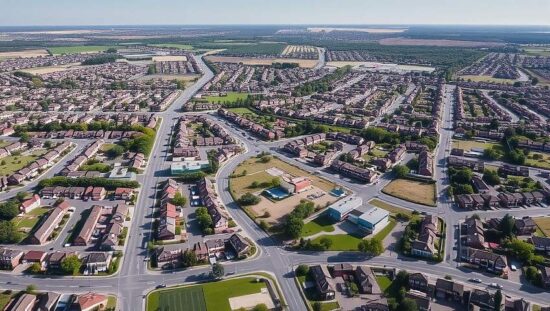
Germany’s relentless expansion of urban and transportation areas is continuing, raising serious questions about the nation’s commitment to ambitious sustainability goals. Data released this week by the Federal Statistical Office (Destatis) reveals that the combined area dedicated to settlement and transportation grew by an average of 50 hectares (approximately 124 acres) daily between 2021 and 2024. While this represents a slight deceleration from the 51 hectares per day observed in the preceding four-year period (2020-2023), the overall trend remains deeply concerning.
The government’s own sustainability strategy outlines significantly more stringent targets, aiming to curtail this daily growth to below 30 hectares by 2030 and ultimately achieve a “circular economy” for land use by 2050 – effectively halting net expansion for settlement and transport purposes. The current rate suggests a considerable shortfall in achieving these crucial benchmarks.
It’s important to note that the “settlement and transport area” measurement encompasses more than just sealed surfaces; it includes unsealed green spaces, gardens, parks and even cemeteries. This broader definition complicates straightforward assessments, but doesn’t diminish the impact of sprawling development. The vast majority – an average of 36 hectares daily – of this expansion is attributed to residential building, industrial and commercial zones and public infrastructure. Increases in recreational facilities, cemeteries and other amenities contribute another 14 hectares daily, while transportation infrastructure has seen relatively little change.
Despite this steady encroachment, settlement and transportation areas represent 14.6 percent of Germany’s total landmass – equivalent to 5.2 million hectares. Of this, 3.4 million hectares are dedicated to residential and industrial uses, while 1.8 million hectares are utilized for transportation.
Land use patterns in Germany highlight a critical imbalance within the nation’s environmental strategy. While vegetation covers an impressive 83.1 percent of the country’s 35.8 million hectares – predominantly comprised of agricultural land (50.2 percent) and forests (29.9 percent) – this is increasingly threatened by the continued expansion of built areas. Just 2.3 percent of Germany’s land is covered by waterways, emphasizing the potential for ecological disruption as development continues to consume valuable natural habitats.
Critics argue that the slow pace of change highlights a systemic problem within German planning and policy. The current rate of land consumption undermines pledges to transition towards a more sustainable and circular economy and raises questions about the effectiveness of current regulations in curbing development pressures. The government will face increasing scrutiny if it fails to demonstrate a significantly steeper decline in land consumption in the years to come, ultimately jeopardizing the nation’s environmental ambitions and potentially causing irreversible ecological damage.