




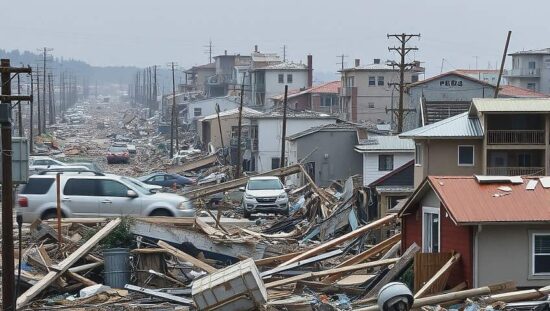
Despite a decrease from the previous year, global losses from natural disasters in 2025 remain exceptionally high, totaling approximately $224 billion, according to Munich Re. The insurance sector absorbed roughly $108 billion of these losses, placing 2025 firmly within a concerning trend of years exceeding the $100 billion threshold for insured damages. While below the adjusted-for-inflation total losses of 2024 ($368 billion, with $147 billion insured), the year underscored a deepening vulnerability to climate-related risks.
A staggering 17,200 lives were lost worldwide due to these disasters, marking a significant increase from 2024’s toll (approximately 11,000), though remaining marginally below the average for the past ten and thirty years. The dominant forces behind the devastation were floods, severe thunderstorms and wildfires, collectively categorized as “non-peak perils”. These events now define the long-term trend, inflicting a combined $166 billion in damage, with $98 billion covered by insurance. Scientists overwhelmingly agree that the increasing frequency and intensity of these types of disasters are linked to climate change across many regions.
The near-miss nature of 2025, where global losses remained below the ten-year adjusted average ($266 billion), highlights a precarious dependence on sheer luck – specifically, the lack of major hurricane landfalls in the United States despite significant storm activity. Had a major hurricane struck the US coastline, the economic fallout could have been substantially worse.
Interestingly, the proportion of uninsured losses, around 50% of total damages, was lower than the ten-year average (approximately 60%), largely due to the high level of insurance coverage for wildfires near Los Angeles, which represented the single most costly disaster of the year. The January wildfires in the Los Angeles area alone resulted in a staggering $53 billion in total losses, $40 billion of which were insured, making it the most expensive wildfire catastrophe on record, claiming 30 lives.
The second most costly disaster was a magnitude 7.7 earthquake in Myanmar, a catastrophe primarily characterized by its humanitarian impact, with approximately 4,500 fatalities. The total damage was around $12 billion, with minimal insurance coverage. The event’s tremors were notably felt in Bangkok, over 1,000 km from the epicenter, revealing a vulnerability within the Thai capital’s unstable, soft alluvial soil which amplified ground movement.
A striking feature of 2025’s natural disaster landscape was the prevalence of extreme events bearing a strong climate change signature. Examples include the Los Angeles wildfires, a heightened intensity of hurricanes in the North Atlantic and widespread flooding. “In a world running a fever, extreme weather events are becoming more probable” stated Tobias Grimm, Munich Re’s Chief Climatologist, emphasizing the direct link to the ongoing climate crisis and adding that 2025 was “again one of the warmest years on record”. This underscores a growing political urgency – the financial burden of these escalating disasters threatens economic stability and necessitates bolder, proactive strategies for climate mitigation and adaptation to protect vulnerable populations and infrastructure.