




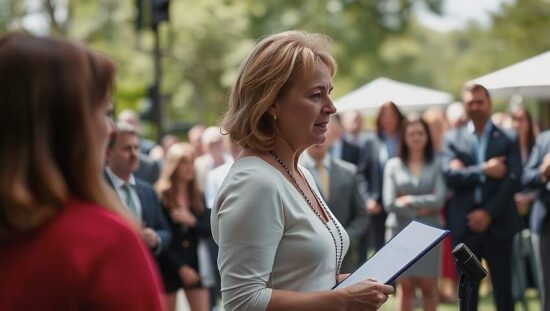
The German Social Democratic Party (SPD) is signaling a cautious approach to climate policy amidst growing economic pressures on German households, while simultaneously facing criticism over perceived inconsistencies in government messaging. Esra Limbacher, the SPD’s parliamentary group deputy leader, emphasized the critical need for reliability and social equity in the nation’s climate action strategy, highlighting the precarious financial situation faced by many consumers.
Limbacher, speaking to Funke-Mediengruppe newspapers, defended the government’s decision to cap the planned increase in the carbon price for 2026, arguing it provides much-needed stability. She stressed that the same principle of measured increases must apply to future years, suggesting a deliberate slowing of the escalating costs associated with climate mitigation.
“It is crucial that politics offers reassurance during times of economic hardship” Limbacher stated, underscoring a sensitivity to public anxiety regarding the financial burden of climate-related policies. The SPD politician further committed to bolstering social support programs, particularly those incentivizing the replacement of heating systems and the purchase of advanced, European-manufactured vehicles. This signals an attempt to soften the blow of climate transition costs on lower-income families.
However, the government’s stance is not without its detractors. Eva Welskop-Deffaa, president of Caritas, a major Catholic charity, sharply criticized the apparent contradictions emanating from Berlin. While acknowledging the importance of upholding ambitious climate targets, Welskop-Deffaa argued that the recent decision to reduce the air travel tax while simultaneously increasing the price of the Deutschlandticket – a subsidized public transportation pass – sends conflicting signals and negatively impacts financially vulnerable households.
“It is the wrong signal to lower air travel taxes while increasing the cost of the Deutschlandticket” she stated in the same Funke interview. Her comments highlight a growing sentiment within civil society that the government’s actions are failing to fairly distribute the burdens of climate policy and risk undermining public support for the urgently needed transition. The debate exposes a core tension: accelerating climate action versus ensuring social cohesion and avoiding disproportionate impact on those least able to absorb the costs. The SPD’s current strategy represents a tightrope walk, attempting to balance ambition with affordability, but faces sustained scrutiny regarding its effectiveness and perceived fairness.