



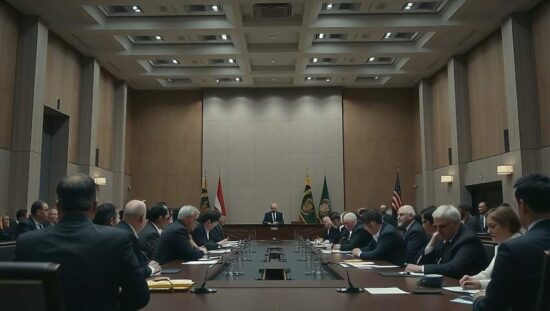
The United Nations Security Council convened an emergency session on Tuesday to address escalating tensions between the United States and Venezuela, triggered by US naval operations off the Venezuelan coast ostensibly aimed at combating drug trafficking. The meeting was initiated by the Venezuelan government, backed by Russia and China and underscored a growing international concern over Washington’s actions.
A significant majority of Security Council members voiced criticism of the US operation. Russia delivered a stark rebuke, condemning the “illegal destruction of civilian vessels” in the Caribbean region. China’s representative reaffirmed the principle of non-interference, explicitly rejecting “all acts of unilateralism and intimidation” and any attempts to meddle in Venezuela’s internal affairs. This stance reflects a broader geopolitical rivalry and China’s consistent opposition to perceived US overreach in international affairs.
France’s statement, while acknowledging the importance of adhering to international law and safeguarding state sovereignty and territorial integrity, adopted a more cautious tone, highlighting the need to address drug-related crime. This approach likely reflects a desire to balance diplomatic concerns with a recognition of the US perspective on combating illicit activities.
The United Kingdom echoed the need for adherence to international law, specifically referencing the UN Convention on the Law of the Sea as a cornerstone of maritime governance. However, the UK representative simultaneously reiterated London’s position regarding the legitimacy of Venezuelan President Nicolás Maduro’s government, signaling a continued lack of recognition and a subtle endorsement of potential regime change scenarios. This divergence in viewpoints – emphasizing international law while questioning Maduro’s authority – highlights the complexities of Western nations’ approaches to Venezuela.
Defending its actions, the US representative asserted a right to “do everything in our power to protect our hemisphere, our borders and the American people”. The US delegation directly accused Maduro of leading a drug cartel and vowed to deplete its resources, presenting the operation as a necessary defense against transnational crime. This rhetoric frames the intervention as a matter of US national security and disregards concerns about potential violations of Venezuelan sovereignty.
Venezuela’s representative responded with a forceful warning, accusing one of the nations present at the Security Council table of publicly advocating for the annexation of Venezuelan territory. Referencing US strategic documents, the representative expressed fears that Washington holds ambitions for continental dominance and views a future where the US possesses control over the continent’s trajectory. This accusation, while inflammatory, taps into existing anxieties regarding US foreign policy and its perceived interventions in Latin America, further exacerbating the diplomatic crisis and threatening to destabilize the region.