




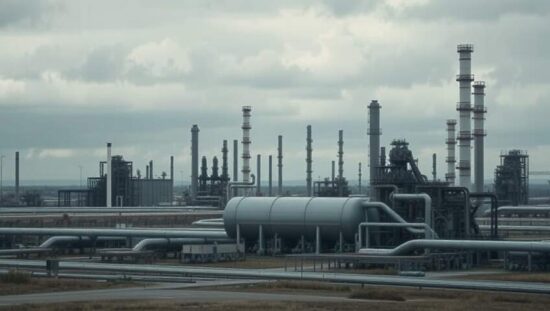
A critical assessment of Germany’s chemical industry reveals a troubling divergence from pledged commitments to “green chemistry” potentially undermining broader climate goals. An analysis by Frankfurt-based data firm Right Based on Science, a service utilized by the European Banking Authority, exposes a significant gap between the industry’s promises and its current emissions trajectory.
The analysis, commissioned by “Der Spiegel”, evaluated published emissions data from five major German chemical corporations. By calculating the discrepancy between their emissions performance and the 1.5-degree Celsius target outlined in the Paris Agreement, benchmarked against their economic output and sector averages, the firm extrapolated a potential global impact. The findings are stark: if industry-wide emissions followed the pattern of just four of these companies, the planet could face a temperature increase of between 4.5 and 6.0 degrees Celsius by 2100.
This outcome casts significant doubt on the industry’s narrative of embracing environmentally sustainable practices. The promise of “green chemistry” built around renewable energy and climate-friendly production methods, was intended to justify the higher cost of German chemical products compared to competitors, particularly from China. However, the lack of substantial investment in emissions reduction, as highlighted by the data, suggests a deliberate hedging of bets.
Hannah Helmke, CEO of Right Based on Science, attributes the industry’s inaction to a perceived risk of regulatory backsliding. While acknowledging the threat of relocation voiced by chemical giants, she raises a nuanced geopolitical perspective. “From a climate perspective” she asserts, “there’s a logic to companies moving to countries where they can access affordable and clean energy”. She specifically points to China’s increasingly substantial investment in renewable energy infrastructure, surpassing that of Germany.
The potential relocation of chemical companies – a phenomenon known as “carbon leakage” – isn’t simply a transfer of emissions. It introduces a complex dynamic where companies may, counterintuitively, find it easier to adopt greener technologies in countries with more robust renewable energy policies than in their current locations. This raises crucial questions about the effectiveness of current German environmental regulations and the potential for international competition to drive genuine “green” industrial innovation – or inadvertently fuel a global race to the bottom in carbon emissions.