


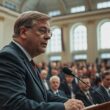

The deterioration of parliamentary discourse within the German Bundestag has prompted concerns from Speaker Julia Klöckner, who acknowledged a marked shift towards increasingly aggressive exchanges while rejecting accusations of adopting an overly authoritarian role. In an interview with the Redaktionsnetzwerk Deutschland, Klöckner attributed the heightened tensions to a confluence of factors, including the impact of digital media and, crucially, the altered political composition of the current legislative body.
Klöckner emphasized the unprecedented nature of the present Bundestag, highlighting the significant presence of fringe political forces: roughly 10% from the far-left and a concerning 25% from the far-right. This polarization, she argued, is visibly fracturing the chamber and directly influencing the conduct of its members. Data reflects this fractured environment, with the majority of procedural interventions and calls to order directed towards members of the Alternative for Germany (AfD), with the remaining sanctions primarily levied against members of the Left party.
The recent reform of the Bundestag’s rules of procedure, intended to foster a more respectful and orderly environment, has struggled to fully address the issue. While Klöckner insists her role is to enforce these established rules impartially, regardless of party affiliation, she also explicitly distanced herself from accusations of heavy-handed governance, stating she is “not the supernanny of parliament.
Her assertion that standards, rights and obligations should apply uniformly underscores a commitment to fairness, yet it also hints at a deeper challenge: the perceived erosion of a shared understanding of acceptable parliamentary behavior. Failing to maintain these standards, Klöckner cautioned, risks descending into arbitrary rule rather than reasoned debate, a critical concern as Germany grapples with increasingly divergent political viewpoints and the complex challenges facing the nation. The speaker’s statements signal a growing anxiety about the long-term health of German democracy and the potential for further destabilization if these trends continue unchecked.