




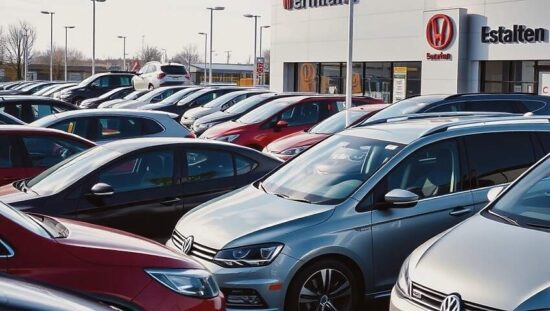
Germany’s automotive market demonstrated surprising resilience in November 2025, with new car registrations climbing 2.5 percent year-on-year to 250,671 vehicles, according to data released by the Kraftfahrt-Bundesamt (KBA). While the overall picture appears positive, a deeper analysis reveals a market bifurcated along commercial and private consumer segments and marked by a complex interplay of established brands and emerging electric vehicle adoption.
A crucial element of the November performance is the contrasting trends between commercial and private registrations. Commercial vehicle registrations, which traditionally dominate the market, experienced a slight decline of 1.0 percent, now accounting for 65.7 percent of total new car sales. Conversely, private registrations surged by an impressive 10.1 percent, signaling a possible shift in consumer confidence or a surge in pent-up demand finally being realized. This divergence raises questions about the health of Germany’s commercial sector and the sustainability of relying so heavily on fleet sales for overall automotive volume.
Among established German brands, Ford experienced the most significant growth, with sales up 13.7 percent and a market share of 3.6 percent. Audi and BMW also recorded considerable gains, at 9.5 percent and 8.5 percent respectively. However, Volkswagen, despite a modest increase of 0.5 percent, retained its position as market leader, albeit with a slightly diminished dominance. Notably, several prominent brands including Smart, Porsche, MAN, Mercedes and Opel saw declines in new registrations, suggesting potential struggles with model offerings or shifting consumer preferences.
The rise of import brands, particularly those focused on electric vehicles, is a noteworthy trend. BYD led the charge with an astounding 834.1 percent surge in registrations, capturing 1.6 percent of the market. Other brands like Fiat, Seat, Citroen, Skoda and Dacia also demonstrated strong growth. However, brands like Peugeot, Toyota, Volvo, Renault, Hyundai and Kia collectively underperformed, highlighting the volatile and competitive nature of the import sector. The rapid growth of BYD, in particular, poses a long-term challenge to established German automakers, signaling a significant shift in market power dynamics.
The electric vehicle (EV) sector continued its upward trajectory, with registrations increasing by a substantial 58.5 percent to 55,741 units, now representing 22.2 percent of all new car sales. Plug-in hybrids accounted for another 12.9 percent. While these numbers appear positive in the context of Germany’s electrification goals, some critics argue the pace of EV adoption remains insufficient to meet the targets outlined by the government, particularly considering the continued high proportion of gasoline and diesel vehicles (24.4% and 11.8% respectively). A welcome, albeit indirect, consequence of the changing powertrain mix was a 14.4 percent reduction in the average CO2 emissions of new cars, falling to 98.3 g/km. Further examination is needed to ascertain whether this trend is sustainable or a temporary effect of evolving registration mixes.