


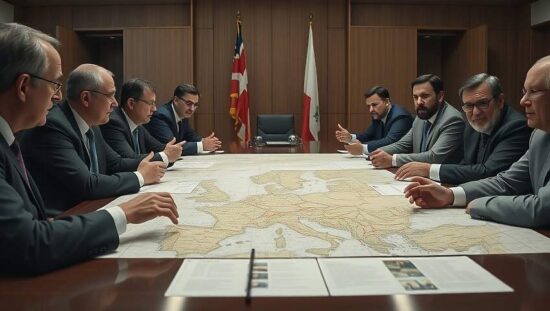
the establishment of a dedicated EU military headquarters and a clearer regulation of the EU’s mutual assistance clause.. Speaking to the news portal “T-Online” Weber stressed the necessity of creating robust European command structures, comparing them to those currently utilized by NATO. “We need a military EU headquarters” he stated.
Given doubts about relying solely on NATO, the German politician argued that Europe must develop its own operational capacities. He pointed out that the EU already possesses a military assistance clause, designated Article 42.7, which could even extend beyond the scope of NATO’s Article 5. Weber urged immediate action, stating, “My appeal is this: Let’s not waste time. We must quickly bring the EU assistance clause to life”. For this to work, he suggested implementing a joint military situation assessment. Furthermore, it is crucial to clarify the precise process by which an attacked country would request and activate the EU’s alliance mechanism.
Weber also highlighted the need for “swift reaction forces, ready for immediate deployment in an emergency” particularly in light of the US troop withdrawal. He suggested that initially, these forces might not require contributions from all EU member states, but rather from a smaller, core group of nations. For this, he advocated creating an “European Security Council” noting that such a body could expand the coalition to include countries outside the EU, such as Great Britain.
While acknowledging that the activation of the alliance mechanism must always be assessed on a case-by-case basis, Weber insisted that the threshold for such activation should be set relatively low. He framed this urgency within the context of Russia’s actions, noting that “Putin is testing us intentionally”. According to Weber, the quicker Europe shows unity and collective will to defend itself, the better. Ultimately, he argued that maintaining peace-the fundamental promise of Europe-is only possible if the continent defends itself as a unified entity against aggressors like Russia.