




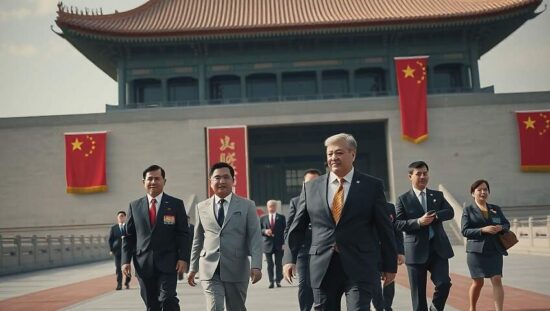
During a recent visit by the U.S. President to China, it was reported that both the President himself and numerous staff members and security personnel left their personal smartphones and digital gadgets at home. Instead, they reportedly utilized specially prepared “clean devices”-meaning temporary laptops and other communication systems thoroughly vetted beforehand-to mitigate risks associated with surveillance, hacking, and data theft.
According to statements from current and former U.S. officials, there has been a long-standing assumption within the American government that every device brought into China, including smartphones, tablets, laptops, or even hotel Wi-Fi connections, must be considered potentially compromised.
The security measures for the presidential visit are so stringent that, according to industry insiders, they significantly complicate even routine communication. News that would typically be sent via encrypted apps or synchronized devices must instead be transmitted through other controlled channels, temporary user accounts, or physical couriers. Furthermore, contacts and cloud access points are frequently either restricted or completely disabled.
Experts have highlighted the pervasive nature of potential monitoring. The former Secret Service agent and current security consultant, Bill Gage, told reporters that representatives traveling to China are intensively briefed on the fact that virtually all communication can be monitored. Theresa Payton, former White House IT Director and current CEO of Fortalice Solutions, echoed this sentiment, advising that officials must assume that both private conversations and digital activities could be under surveillance.
These precautions extend to even seemingly mundane activities, such as charging phones. U.S. authorities have warned for years against using unknown USB ports or unfamiliar charging systems due to the risk of manipulated hardware being employed to extract data or install malware, a tactic known as “Juice Jacking”. Consequently, U.S. representatives traveling to high-risk countries commonly carry only specifically authorized chargers or external power banks.
For extremely sensitive discussions, authorities abroad are also establishing temporary secure zones known as SCIFs (Sensitive Compartmented Information Facilities). These are often improvised, mobile rooms designed to prevent electronic surveillance-such as a speaking area set up within a typical hotel room-and the President must move into such a space to make a phone call.
The sheer bulk of security protocols dictates that delegations often have to revert to analog work methods, leading to the increased use of physical paper documents.
From the perspective of Western intelligence and cybersecurity experts, China employs a comprehensive mix of traditional intelligence methods, cyberattacks, technical surveillance, and information gathering through personal connections. While noting that many other nations also conduct espionage, the Chinese system is considered particularly extensive and technologically advanced.
For instance, a report from the British National Cyber Security Centre, published in cooperation with German intelligence and international partners, noted that “state-sponsored Chinese cyber actors have continuously adapted their tactics and techniques in recent years”. These attackers reportedly use networks of compromised endpoints owned by corporations and private citizens to discreetly monitor targets and obscure digital tracks, potentially utilizing computers, mobile phones, routers, or smart-home devices.
Despite these sophisticated claims, the Chinese government regularly dismisses allegations of systematic espionage, stating that it may itself be a target of Western cyberattacks.