




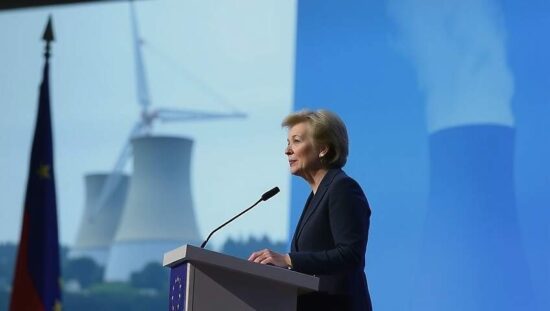
Ursula von der Leyen, the President of the European Commission, has called the recent shift away from nuclear power in Germany and parts of the EU a “strategic mistake”. Speaking at a nuclear summit in Paris, she contrasted the global reach of European wind‑turbine makers with the retreat in the nuclear sector. In 1990 nuclear energy supplied about a third of European electricity; today it accounts for only around 15 %. She emphasized that this decline was a conscious choice and warned that turning away from a reliable, cheap, low‑emission source is detrimental for Europe.
Von der Leyen said that nuclear and renewable energies should not be seen as an either‑or proposition. When combined they form the strongest, most balanced energy portfolio-clean, affordable, resilient, and of European origin. While renewables generate power at the lowest cost, they are intermittent, tied to weather, and often located far from major industrial hubs, which is why investment in storage, demand flexibility, and grid expansion is essential.
She affirmed that nuclear power continues to be a dependable, 24‑hour supply source. An integrated system of the most efficient nuclear plants alongside renewables, supported by storage, flexibility, and enhanced networks, is the key. Moreover, the EU’s pioneering role in nuclear technology could be re‑established; next‑generation reactors could become high‑value exports on a global scale-an ambition that brought the discussion to Paris.
In that spirit, she unveiled a new European strategy for small modular reactors slated to be operational by the early 2030s. The plan is built around three focus areas: streamlined regulatory rules, mobilization of investment, and strengthened European cooperation. The objective is to position Europe as a “global hub for next‑generation nuclear power”.