



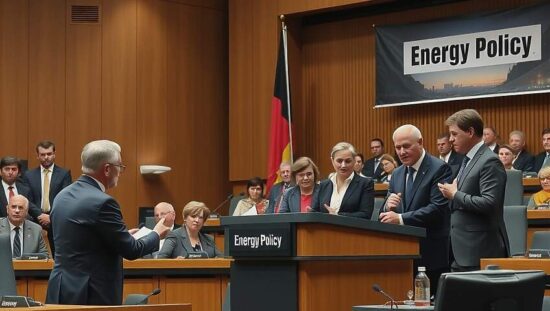
The Union and the SPD in the Bundestag dismissed the Green caucus’s warnings of an imminent gas shortage in Germany.
Green energy spokesman Michael Kellner had accused Economy Minister Katherina Reiche (CDU) of inaction; his party now wants Reiche to be called before a special session of the Energy Committee.
Andreas Lenz (CSU), the Union’s economics‑and‑energy spokesman, told “Die Welt” that the supply situation is “monitored closely every day”. He compared the current climate with that of 2022, noting that the main supply now comes from Norwegian pipeline gas, with LNG terminals and storage facilities as backups. “We have met the statutory storage‑fill‑level requirement of 30 % by 1 February” Lenz said. “Mr Kellner should know that the revised regulation was still enacted under Robert Habeck’s and my tenure as state secretary”.
The SPD partner explained that the supply is “seasonally secured” thanks to the measures put in place by the previous Social‑Democratic, Green and FDP coalition. “The safeguards established by the traffic‑light coalition still successfully ensure that gas is sufficiently available” said SPD energy spokesman Nina Scheer to “Die Welt”. “These safeguards include the legal storage‑fill‑level requirements and the expansion of additional LNG docking capacities”. Scheer also argued that demanding more gas availability fails to recognise that every additional gas reserve has price‑impact, ultimately pushing energy prices higher and contradicting the interest in affordable energy.
AfD parliamentarians criticized the Greens, describing them as “arsonists posing as firefighters”. AfD energy spokesman Steffen Kotré accused the Greens of refusing cheap Russian gas, of not reacting politically to the sabotage of the Nord Stream pipeline, and of working with the SPD to delay the certification and commissioning of Nord Stream 2. He further claimed that, due to the failed energy transition, expensive gas must be streamed, making the Greens responsible for the current shortage that the federal government now has to manage.
Left‑wing energy politician Lorenz Gösta Beutin condemned the policy of Economy Minister Reiche, calling the decision to build new gas plants “devastating”. He said it entrenches fossil dependence on autocratic regimes, wastes public money through subsidies, and delays the urgently needed expansion of renewables instead of ensuring long‑term, socially fair supply security. His party demands stronger public oversight of gas supply, effective price caps, and the nationalisation of energy networks.
Kellner reiterated his critique in “Die Welt”: “Storage levels are falling. In cold weather, imports from the Norwegian pipeline are not enough. It is particularly unclear, given market developments, how gas will be refilled”. He argues that “adapted rules” are needed, but the government shows no corresponding vigor. Kellner sees the Bundesnetzagentur’s proposal of a national gas reserve as a possible solution and calls the concept worth considering.