




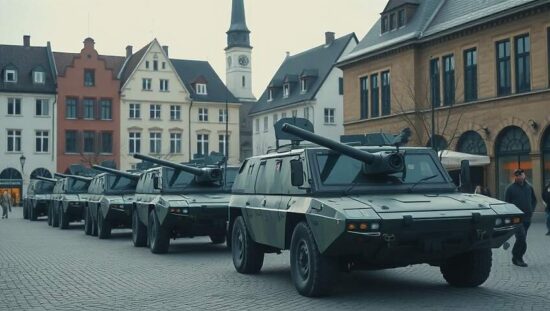
The proposed limited withdrawal of US troops from Germany has drawn sharp criticism across the political spectrum. Defense policy expert Siemtje Möller of the SPD argued that the continued US presence is fundamentally rooted in the mutual security interests of both countries, suggesting that the United States has benefited substantially from this arrangement. She described the US announcements as erratic and the planned withdrawal as strategically unplanned. According to Möller, the US remains heavily reliant on both the infrastructure and the partnership established through the troop deployment in Germany, warning that the stability of the NATO alliance and European security now appear increasingly vulnerable to the arbitrary decisions of the US presidency. Consequently, the SPD called for Europe to accelerate investment and strengthening of its own domestic security architecture.
The Christian Democratic Union (CDU) also expressed deep concern, stating that the withdrawal threatens the credibility of conventional deterrence, a credibility built over decades. CDU foreign policy expert Jürgen Hardt emphasized that the strategic role of US forces cannot be underestimated, citing critical sites such as the European Command in Stuttgart, Ramstein as a key logistics hub, and medical facilities in Landstuhl and Weilheim. While hoping that the decision is not irreversible and can be adjusted through further consultation, the CDU urged the government to mitigate the resulting tensions and maintain the robust trans-Atlantic cooperation achieved in previous years.
Conversely, Sören Pellmann, the chair of the Left Party parliamentary group, dismissed the discussions as mere “hot air”. The Left Party has long demanded the closure of US military bases in Germany, arguing that current military operations violate the peaceful tenets of Germany’s Basic Law. For Pellmann, every soldier departing Germany represents progress.
Adding complexity to the debate, military experts highlighted immediate practical concerns. Salah Masala pointed out that the cancellation of the previously agreed-upon deployment of Tomahawk cruise missiles and Dark-Eagle hypersonic missiles in Mainz-Kastel would create a significant capability gap in deterring Russia-a vacuum that could not be filled by European weaponry in the near future. Generally, there is concern among experts regarding the lack of a clear conversion plan or transitional roadmap. One source noted that reacting only after a decision has been finalized makes structural change both more costly and socially harder than necessary. Furthermore, it was reported that approximately 12,000 people nationally, including around 6,500 workers in Rhineland-Palatinate, currently work for US forces stationed in Germany.