




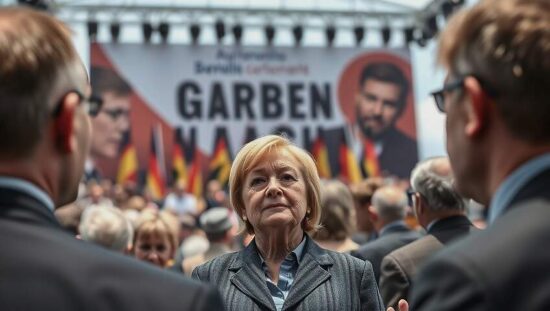
Speaking at the DGB Congress, Federal Labor Minister Bärbel Bas largely avoided sharp attacks on the Chancellor. It was noted that Christian Lindner had been heckled by union workers earlier that morning at the very same location.
Instead, Bas focused on highlighting apparent successes and painting a picture of deep-seated changes. She pointed to global complexities such as wars, punitive tariffs, world market uncertainties, high energy costs, the rapid transformation driven by artificial intelligence, and the conflict in Iran. Given that many citizens are questioning job security, the feasibility of commuting at high fuel prices, and their overall financial stability, Bas stated that the federal government must collectively provide answers-and admitted that this is not always simple, and she didn’t want to sugarcoat the difficulties.
While doing so, Bas also emphasized the differences between the SPD and the Union, stating that such clear distinctions were rarely noticeable, especially concerning pensions, health insurance, workers’ rights, and working hours. Regarding working hours, she noted that the SPD and she personally would not even initiate the debate, especially since the topic was already included in the coalition agreement. However, she remained committed to exploring a possible agreement with social partners, despite previous failures in dialogue. “I will continue to fight against the reduction of workers’ rights, particularly concerning the health and safety of employees. You can count on that”.
Bas claimed that after a year in government, achievements were visible. She highlighted the increase in the minimum wage, stating that “über the minimum wage commission, one could clearly see how important functioning social partnership is”. She also mentioned that the government is investing 500 billion euros in infrastructure, digitalization, and modernization, alongside “clear social standards” established by the Collective Agreement Law, which took effect on May 1st. She stressed that public money must not be used for wage dumping, and warned that adhering to collective agreements “cannot be the fool for longer”.
The minister announced a national action plan to strengthen adherence to collective bargaining. Another supposed success she cited was the extension of the pension safeguarding line, noting its passage despite significant opposition. She argued that a fair pension is not a luxury, but something that must be “hard-earned and deserved”.
Bas clarified that the proposed modernization of the welfare state does not imply cuts. “Reform does not mean reduction. I want to make our social security not smaller, but smarter”. She committed to implementing the recommendations of the Social State Commission fully, pointing to the introduction of the application-free child benefit scheme as a first step. She credits the “pressure and support of the unions” for achieving these favorable results.
Addressing her controversial statements from the previous week during a government hearing, wherein she claimed there was no immigration into German social systems, Bas expressed her disdain for right-wing extremists who pit different immigrant groups against one another for their own political gain. She stated that those fleeing persecution, war, and terror, or those valuable as skilled workers, are welcome. However, she reinforced her position that they strongly reject and combat misuse of social benefits, as such misuse harms those who genuinely need support.
Defending her policy stance against criticism from the business sector, she asserted that economic growth cannot be achieved by undermining worker protection or by exploiting employees. Instead, the foundation for economic success requires investment, modernization, fair wages, co-determination, worker protection, and social security. “If I am called a blocker for doing this, I can endure it”. She concluded that politics operates not on maximalist demands, but on conviction, clarity, and the commitment to achieving the best possible outcomes.
Bas called for an active industrial policy, arguing that “European steel must be better protected from unfair competition”. She criticized other countries for already protecting their industries massively, insisting that Europe must act with greater determination.
Regarding artificial intelligence, she warned against mass layoffs, arguing that if implemented correctly, AI can be a genuine gain. She pressed for a comprehensive employment data law, better qualifications, co-determination, and a “joint national effort”. She emphasized that the use of AI must be developed “with” employees, not against them.
Turning to the training market, she raised concerns about the surplus of applicants with no apprenticeship positions and the number of vacant training slots. She urged employers to offer more opportunities, particularly to young people with support needs, and called for the strengthening of youth employment agencies.
Bas criticized the situation where many women remained in small-time part-time roles because the financial incentive was lacking. “We must change this. We need this workforce, especially this wealth of experience”. She also stressed the need for fair labor migration: “no exploitation, no dumping wages, equal rights, and fair mobility”. The Labor Minister concluded by assuring the union workers that the Work-and-Stay agency would contribute significantly to addressing this issue.