


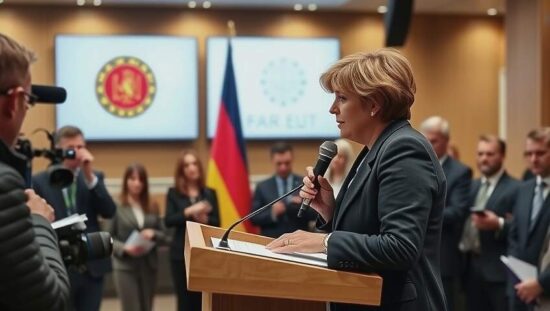
German Economy Minister Katrin Reiche (CDU) said that industry will be allowed to emit more CO₂.
In an interview with “Bild” (Saturday edition) she told the paper that she has recommended the European Commission not to remove more permits from the market, thereby avoiding further increases in the CO₂ price. Reiche added, “First for the coming years, because we need stability not only during the crisis but for a period of economic hardship across Europe”.
Reiche described the EU Emissions Trading System (ETS) for the energy and industry sectors as being under “great pressure” and remarked that she hears the Commission truly wanting to act. In the EU ETS, a cap on CO₂ emissions is set. Companies that emit roughly one tonne of CO₂ per tonne of natural gas burned must purchase certificates. The total number of certificates is divided over several years, so the available supply – and thus permissible emissions – falls each year.
If companies draw down their demand more slowly than supply shrinks, certificate prices rise. Economic estimates suggest that, to fully decarbonise the industry sector, the price will need to climb from today’s about €80 to somewhere between €200 and €300 in the medium term. Keeping the annual supply of certificates constant would either raise CO₂ emissions relative to earlier plans or force higher cuts later, leading to even sharper price spikes.
Reiche also wants to ensure that free CO₂ certificates continue to be allocated to firms. She said that she has discussed this with the Commission. “There is an urgent plea from energy‑intensive industries – chemicals, steel, paper and cement – that they receive free certificates not only until the early 2030s but until the 2040s, so that they are not further burdened by the CO₂ price” she stated.
According to the current scheme, the annual quantity of certificates will fall by 4.4 % from 2028, with a complete cessation of allocations by 2040. Revenues from the initial phase of the EU ETS in Germany are earmarked for the Climate and Transformation Fund (KTF), which supports investments such as electric‑charging infrastructure and the expansion of the hydrogen sector. A free allocation of certificates would reduce future revenues and, in turn, cut the funds available to help decarbonise the affected industries.