




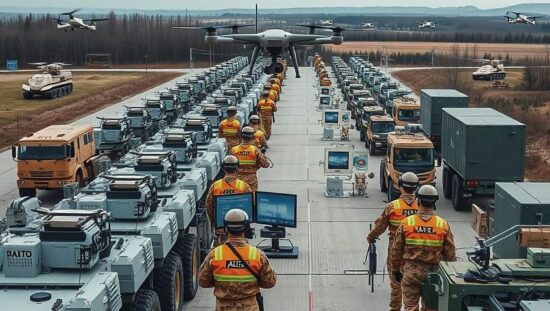
NATO plans to dramatically increase its military presence along the Russian border over the next two years, adding significantly more stored weapons and ammunition. Brigade General Thomas Lowin, deputy chief of the NATO Operations Staff in Izmir, told “Welt am Sonntag” that “we will see noticeably larger stocks than before in the NATO border states to Russia, including weapons and ammunition depots for rearming defense systems in the automated zone, but also for equipping NATO forces”.
Lowin also explained that NATO intends to build a “complex, multilayered defense system” along the borders with Russia and Belarus. The strategy is not simply to deploy conventional troops; instead it will use obstacles and technology to create a robotized or automated zone that the adversary must first cross. He noted that this is the first public statement by a NATO general on the new concept, dubbed the “Eastern Flank Deterrence Line” (EDFL). According to the newspaper, the program is expected to be underway by the end of 2027.
The EDFL will rely on a system of reconnaissance sensors and largely automated, roboticized weapons designed to hold back Russian forces in the initial phase of an attack while sparing NATO soldiers. Lowin described the “Joint Effects Zone” as a clearly structured, layered operational space that immediately engages enemy troops and exerts pressure-an “activated zone”. The goal is to halt any hostile advance, channel movements, slow the enemy, force suboptimal positions, and gradually erode their combat power. Every measure aims to reduce the adversary’s effectiveness while keeping NATO forces fully operational.
The automated zone envisioned near Russia and Belarus is intended to be almost devoid of human presence. Lowin said it will feature sensors and effectors that work seamlessly: sensors detect the enemy, alert the system instantly, and activate the connected effectors. These include armed drones, semi‑autonomous combat vehicles, unmanned robotic ground systems, and automated air‑ and missile‑defense. He added that these interconnected systems are designed to swiftly confront the enemy, break their actions, and reliably deny them combat power and initiative.
Pilot projects implementing elements of this concept are already being tested in Poland and Romania.