




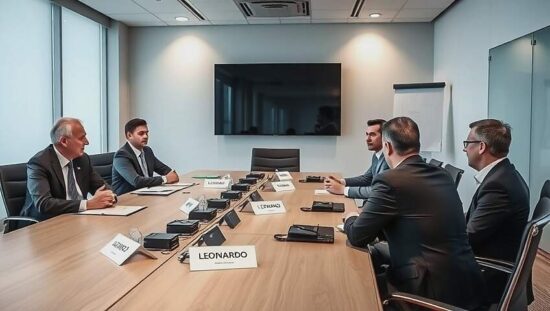
Leonardo, the Italian defence company, is preparing for a scenario in which the German‑French Future Combat Air System (FCAS) project fails. CEO Roberto Cingolani, who heads Leonardo’s own fifth‑generation fighter program GCAP together with BAE Systems from the UK and Mitsubishi Industries from Japan, told reporters that he would welcome a larger consortium that could bring additional technologies and resources to the effort.
Under GCAP, the envisaged sixth‑generation fighter will be accompanied by unmanned drones and backed by artificial‑intelligence‑based systems. Cingolani likened the challenge to the moon landing, and said GCAP could contribute to the development of drones, command‑and‑control systems and swarm‑intelligence technology. He welcomed the possibility of Airbus joining the existing consortium, but made it clear that any decision would have to come from the respective governments.
Airbus Defence and Space, together with French partner Dassault Aviation and Spanish firm Indra Sistemas, is also working on FCAS. Germany and France, however, have clashed over leadership, workload division and system requirements. Airbus representatives and the German government have recently floated a solution that would incorporate two distinct jets within FCAS. Cingolani described such an arrangement as “charming” and suggested that Airbus-or even another manufacturer such as Sweden’s Saab with its Gripen‑jet-might partner with GCAP on a smaller, faster aircraft.
Cingolani also expressed doubt that Europe will create space for two new air‑combat systems. “Sixth‑generation fighters are not bought like potatoes” he said. With China and the United States developing and selling their own jets to clients within their spheres of influence, Europe would be limited to a handful of buyers: the European Union, a handful of Gulf states and Japan.
He rejected the idea of a merger between European defence giants such as Leonardo, Rheinmetall and BAE Systems, noting that he shares a similar long‑term vision with Rheinmetall CEO Armin Papperger. “At the moment European defence is in crisis because of the war in Ukraine” Cingolani said, “so it is not the right time for a merger”. Instead, he sees the future in powerful joint ventures.
Finally, Cingolani criticized Germany’s rising self‑assertion in European defence policy. “I know how capable the Germans can be, but having money does not automatically give you a leadership role” he said. “In the defence industry it’s now about technological leadership, and that race has only just begun”.