



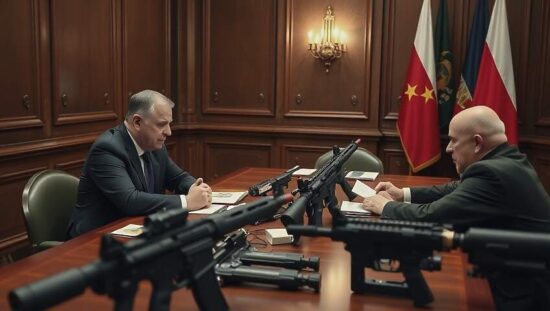
The proposal made by Wolfgang Ischinger, chair of the Munich Security Conference, to give Poland weapons in order to ease the neighbouring country’s concerns about the German armed forces’ rearmament has met with skepticism among German politicians and security experts.
“Offering a country that has, over the past few years, been building one of NATO’s strongest conventional forces a strong gift of weaponry seems somewhat bizarre, even paternalistic” said Carlo Masala, professor of international politics at the German Armed Forces University in Munich, to “Die Welt”. “We normally do this with smaller states in the global south under the security initiative, because they lack the financial resources to equip their forces with modern equipment”.
Marie‑Agnes Strack‑Zimmermann, chair of the European Parliament’s Defence Committee and member of the Free Democratic Party, recalled a 2011 remark by Polish Foreign Minister Radosław Sikorski, who, amid the Euro crisis, said, “I fear a strong Germany more than a weak one”. Strack‑Zimmermann added to “Die Welt” that “we should focus on building a common European defence, a goal that the continent is waiting for. No one should distract us, let alone allow a handful of people who fear alleged German dominance or domestic politics, which fuel the Polish narrative of reparations, to wield influence”.
Thomas Erndl, a spokesperson for the Union faction in the Bundestag and member of the Christian Social Union, responded with a negative stance. “A strong Bundeswehr protects Germany and its allies. Our efforts therefore aim at the material and personnel modernisation of the forces-an outward expression of German responsibility for European security that we secure together with our partners” Erndl said. He noted that this is especially appreciated in Eastern Europe, stating that “if we concentrate all our efforts on quickly expanding our military capabilities and thereby guaranteeing the safety of Europe, historical sensitivities will play a secondary role in my view”.
Speaking to “Die Welt”, Adis Ahmetovic, the foreign policy spokesman of the SPD faction, said, “Wolfgang Ischinger’s analysis rightly points out that Germany will bear an enormous responsibility in the coming years-not least because the US administration under President Trump increasingly questioned its alliance loyalties. Europe must therefore significantly strengthen its own contribution within NATO”. Ahmetovic stressed that trust is built through reliable and close cooperation, not through symbolic gestures such as military gifts, and urged a consistent deepening and development of proven formats such as the Weimar Triangle.
Agnieszka Brugger, spokesperson on security policy for the Greens, called the eccentric proposal more confusing than helpful. “It is about trust, cooperation, leadership, and determination: you can’t buy that with money, words, or military hardware alone-you must earn it through actions and courage”. She warned that attaching the notion of gifts to the sensitive issue of reparations is ill‑advised. Brugger also acknowledged the concerns voiced by partners that Germany might become politically and militarily dominant in Europe, noting that these worries are not just abstract figures of tanks but relate to political forces and extremist ideologies that might be revived in Germany, thereby reminding neighbours and friends of the darkest chapters of German history.
Hans‑Peter Bartels, president of the German Security Council, expressed openness toward the suggestion. He argued that the Bundeswehr has difficulty recruiting enough personnel for the ordered weapon systems, so Ischinger’s proposal warrants consideration: “Poland also defends us”. CDU foreign policy politician Roderich Kiesewetter agreed that the idea is fundamentally worth considering but not sufficient to erode mistrust. “We cannot shirk our responsibility to defend Europe by simply handing out a few tanks” Kiesewetter told “Die Welt”.
The Christian Democrat suggested that Germany should instead consider a forward‑deployment of material, namely additional air‑defence systems and extended‑reach capabilities in Poland and the Baltics. He added that “it would also make sense, akin to the German‑Dutch cooperation, to integrate a German brigade or several battalions into the Polish armed forces”. Such personnel cooperation, he argued, would make it far clearer that Germany is deploying its combat power for our partners in the alliance, not just for its own national defence.