

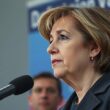

Bundesgesundheitsministerin Nina Warken (CDU) said she will only partially adopt the cost‑cutting proposals of the Health Finance Commission. In an interview with the “Frankfurter Allgemeine Zeitung” on Saturday she explained that she would not simply copy the commission’s recommendations. In particular, she rejects the proposal to restrict the free, compulsory joint coverage of spouses and civil partners in health insurance.
She points out that the commission intends to exempt only pensioners and people whose children are not yet compulsory school‑attending from future obligatory insurance-an exemption she deems insufficient. “For example, caregivers provide such an important contribution that I find it ungrounded to financially burden them at this point” Warken told the FAZ.
Other suggested savings, such as limiting unnecessary skin‑cancer screenings or the placement of too many orthodontic appliances on children, have raised her concerns. Conversely, she welcomed the idea of raising the patient co‑payment for prescription drugs by roughly 50 %, setting it at €7.50 to €10 per package. “The proposal to raise the pharmacy co‑payment modestly next year, after more than two decades of stability, is understandable” she said.
She also agreed with the idea of discontinuing the additional remuneration for private doctors for extra appointments. “The Federal Court of Auditors criticized that additional payments outside the budget did not reduce waiting times, and we cannot ignore that” Warken clarified. “Therefore it is entirely appropriate to question such an instrument”.
However, she criticized the reaction from the networked doctors: “I find it wrong that private doctors now threaten that less money means fewer appointments and poorer care” she remarked in the FAZ. “One cannot always shift the responsibility to others when cutting costs”.
Warken expressed understanding for the pharmaceutical industry’s criticism. The industry has rejected, among other proposals, the doubling of the medication discount for sickness funds to 14 percent. The companies face major challenges, such as the tariff threats from U.S. President Donald Trump, Warken noted. “The risks to the German industrial base must be taken very seriously” the minister told the FAZ. “We cannot call for more resilience, supply security, and reshoring, and then do nothing to keep the industry in Germany”.
She acknowledges that the pharma sector also bears a share of the savings. “However, we must relieve them elsewhere, for example by easing regulation and bureaucracy” she stated. She is confident that, with the planned measures, the average additional contribution to health insurance can be frozen at 2.9 percent until 2030, a law she aims to submit by July.
In the coalition with the SPD, she expects controversial discussions. “I am confident that everyone is aware of their responsibilities and understands that the status quo cannot continue, especially if we are to maintain the solidarity community” she said. “I am currently assembling a package that may not please all political stakeholders, but it is majority‑eligible”.