




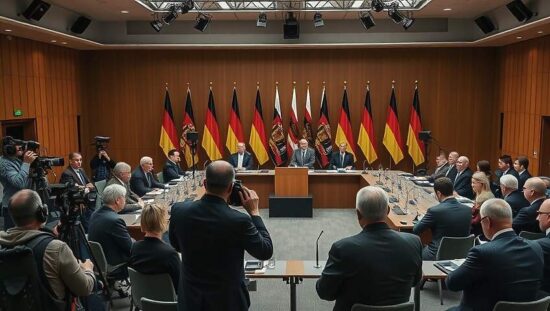
The new German government chemistry agenda, called Chemieagenda 2045, contains several short‑term “immediate measures” that should be implemented by 2027. Federal Minister for Economic Affairs Katherina Reiche (CDU) and Minister for the Environment Carsten Schneider (SPD) plan to unveil the agenda over lunch on the 2045 day.
Immediate measures include the planned introduction of an industrial electricity price and an expansion of electricity‑price compensation. The agenda is divided into three phases. Phase 2, “Transformation and scaling”, runs from now through the 2030s, and Phase 3, “Industrial transformation and technological leadership”, starts thereafter. The overarching goal is to make Germany the world’s most innovative hub for chemicals, pharmaceuticals, and biotechnology.
A key focus is the emissions‑trading system. The strategy seeks to use Brussels’ upcoming ETS‑1 reform to balance competitiveness and climate protection. It proposes structural adjustments to the benchmark devaluation to better safeguard against carbon leakage without disadvantaging climate‑neutral technologies. Furthermore, new ETS licences will enter the market after 2039, with a reduced linear reduction factor from 2036 onward.
The CO₂ border adjustment mechanism (CBAM) is criticised for offering no lasting carbon‑leakage protection to the chemical industry. CBAM may encourage industry to relocate outside the EU to avoid the cost of carbon certificates, and the agenda highlights its potential for circumvention and high administrative burden.
The Clean Industrial Deal State Aid Framework (CISAF) will be refined to meet the target of an industrial electricity price of €50 per MWh and to provide long‑term relief for electricity costs. Gas supply will be expanded to secure competitive prices. The government will examine whether the RFNBO industry quota should be adjusted to match the realities of the hydrogen ramp‑up, and CO₂ differential contracts will be normalised.
The agenda was drafted with input from the Ministries of Finance, Labour, Research, Digital Affairs, and the Chancellery, and involved the federal states, industry groups, and labour unions. It addresses energy and climate policy, innovation, regulation, and competitiveness.