




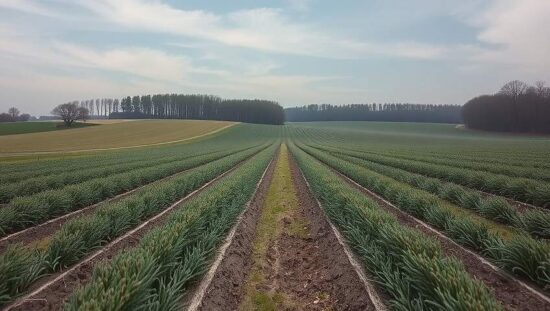
Asparagus cultivation in Germany has been shrinking. In 2025 the country harvested 103,900 tonnes of asparagus, a decline of 3.9 % compared with 108,100 tonnes in 2024 and 8.5 % compared with 113,600 tonnes in 2015. The total cultivated area fell to 22,500 hectares, 1.5 % less than the 22,800 hectares recorded in 2024 and 12.5 % below the 25,700 hectares reported in 2015.
A major factor behind the reduced yield is the decrease in the number of farms. In 2025 the number of asparagus‑producing estates dropped to 1,350, a 29.3 % reduction from the 1,900 farms operating in 2015. Small‑scale growers, in particular, have retreated from the crop in recent years, causing the decline in farm numbers to outpace the drop in both area and harvest volume.
The most active states in terms of farm counts were Bavaria (290), North Rhine‑Westphalia (265) and Baden‑Württemberg (210). By cultivated area, the largest regions were Lower Saxony (4,300 ha), North Rhine‑Westphalia (4,100 ha) and Brandenburg (4,000 ha).
Germany also imports a significant amount of asparagus. In 2025, 24,500 tonnes were brought in from abroad, amounting to roughly one‑quarter of domestic production. This was a 6.4 % increase over 2024 (23,100 tonnes) and a 3.4 % rise from 2015 (23,700 tonnes). Most of the imports arrived during the asparagus season, with 79.4 % of the 2025 imports entering the country between March and June.
The key source countries in 2025 were Spain, which provided 26.8 % of the imports (6,600 tonnes), followed by Mexico (19.7 %, 4,800 tonnes) and Greece (19.6 %, 4,800 tonnes).
Exports from Germany also displayed a small decline. In 2025, 4,500 tonnes were exported, 2.7 % less than the 4,600 tonnes shipped in 2024, but 13.0 % more than the 4,000 tonnes exported in 2015.