




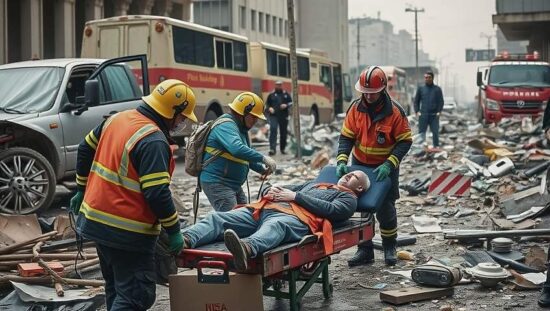
Germany has taken in eleven severely injured individuals following the devastating fire in the Swiss ski resort of Crans-Montana, utilizing a coordinated mechanism previously employed during the COVID-19 pandemic. The Federal Office for Civil Protection and Disaster Assistance (BBK) confirmed on Sunday that the distribution of patients followed the ‘cloverleaf mechanism,’ a system developed collaboratively by the federal government and individual states to manage surges in critical medical needs.
Four of the transferred patients arrived under existing bilateral agreements, with three directed to hospitals in Baden-Württemberg and one to Rhineland-Palatinate. A further seven were relocated via the EU Civil Protection Mechanism, receiving specialized care across facilities in Bavaria, Rhineland-Palatinate, North Rhine-Westphalia, Lower Saxony, Saxony-Anhalt and Berlin. The complex logistical operation involved both air ambulance and fixed-wing aircraft transport.
The Swiss authorities have indicated that, for the immediate future, they require no further transport or treatment assistance. Across Belgium, Germany, France and Italy, the EU Civil Protection Mechanism facilitated the transfer of a total of 35 patients – many suffering from severe burn injuries – to specialized clinics. This pan-European effort involved transport coordination from France, Italy, Luxembourg, Romania and Switzerland, supplemented by on-site support from specialized burn treatment teams dispatched from France and Italy.
The Crans-Montana fire, which tragically claimed the lives of 40 individuals on New Year’s Eve and left 119 injured, has prompted immediate criminal investigations into the bar operators where the blaze originated. Authorities are pursuing charges of negligent homicide, negligent bodily injury and negligent arson, raising crucial questions surrounding safety regulations and operational oversight at the establishment. The swift deployment of resources and the activation of established EU protocols highlight the importance of international cooperation in disaster response, but also underscore the need for rigorous preventative measures to avert such catastrophic losses of life. Critics are already questioning whether existing regulations were adequately enforced and whether a more proactive approach to risk assessment could have mitigated the scale of this tragedy.