




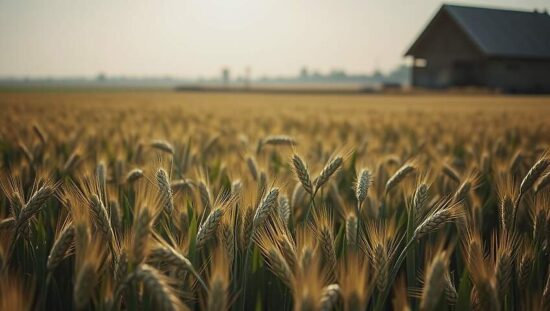
For the 2026 harvest season, German agricultural operations are estimated to dedicate 6.03 million hectares to growing grains. This represents an increase of 1.8 percent, or 108,200 hectares, compared to the 2025 figures, according to current estimates from the Federal Statistical Office (Destatis). Doing so, the cultivated area would surpass the level observed in 2023. This contrasts sharply with 2024, when adverse weather conditions led to the lowest recorded area since 2010. In 2025, the area had already shown a recovery, rising by 4.4 percent from 2024. Nearly half of this total acreage (48 percent) will be used for winter wheat (including spelt), covering 2.9 million hectares-an increase of 1.5 percent compared to 2025.
Winter grains remain the core focus of German grain cultivation. In 2026, approximately 5.0 million hectares will be dedicated to winter grains-a 2.3 percent rise over 2025, accounting for 82.9 percent of the total grain acreage. This encompasses not only winter wheat but also winter barley, rye, and triticale (a wheat-rye cross). Specific projections for the 2026 season show that 1.26 million hectares will be sown with winter barley (up 4.3 percent), 533,600 hectares for rye (up 0.8 percent), and 301,500 hectares for triticale (up 4.8 percent).
Cultivation for summer grains will be significantly less extensive than for winter grains. The total area for summer grains is anticipated to be 1.03 million hectares, a slight decrease of 0.4 percent from the previous year. Crops in this category include 505,900 hectares for corn (including corn-cob mix) (up 3.3 percent), 50,500 hectares for summer wheat (up 5.9 percent), and 189,900 hectares for oats (up 1.5 percent). Notably, the area for summer barley is set to decline, dropping to 287,100 hectares-a reduction of 8.2 percent, or 25,800 hectares, compared to the 2025 harvest.
For other major crops, silomais is expected to utilize 1.93 million hectares, maintaining a level similar to the previous year (-1.4 percent). Winter rapeseed will increase its planting area by 53,500 hectares, reaching 1.14 million hectares (up 4.9 percent) compared to 2025. However, a reduction in cultivated land is expected for root crops. Potato cultivation is projected to fall to 280,400 hectares, down by 7.1 percent or 21,400 hectares from 2025. Similarly, the area for sugar beets is expected to shrink by 12.6 percent, decreasing by 48,700 hectares to reach 338,700 hectares.
Legumes, taking up a relatively modest portion of the general farmland, are also projected to see increases in planting areas for 2026. According to estimates, the area for peas for grain production will rise by 6.6 percent to 147,400 hectares, while field beans are expected to increase by 5.9 percent to 70,300 hectares. Soybeans are predicted to see the largest percentage jump, rising by 17.8 percent to cover 51,000 hectares.