




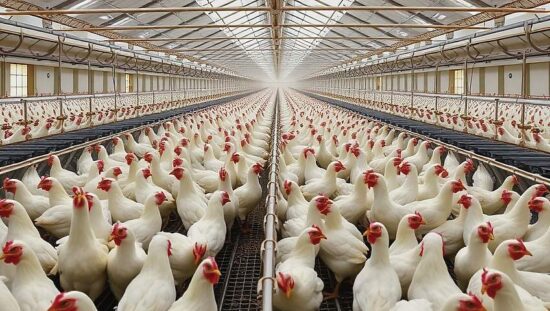
In 2025 German egg‑producing businesses with at least 3 000 hen houses manufactured about 13.7 billion eggs, a 0.5 % rise – roughly 64 million more than the 2024 total. Across the surveyed farms an average of 45.2 million laying hens was recorded, giving each hen about 304 eggs that year.
Ground housing remains the dominant system, producing 57.6 % of all eggs (≈ 7.9 billion). The share of eggs from ground housing fell slightly from 58.0 % in 2024. The number of hens in ground housing decreased 0.9 % to 25.9 million, yet the egg output stayed almost unchanged at 7.9 billion, a 0.2 % drop of about 17 million eggs. Roughly half of these eggs came from Niedersachsen (34.7 %) and Nordrhein-Westfalen (12.8 %).
Free‑range production grew more strongly: the share of free‑range eggs rose to 24.7 % (≈ 3.4 billion), up 5.2 % and 167 million eggs from 2024. The average free‑range flock expanded by 5.0 % to 11.2 million hens – an increase of 538 000. Free‑range eggs are mainly produced in Niedersachsen (45.0 %) and Mecklenburg‑Vorpommern (10.7 %).
Organic (ökologisch) laying also increased. The flock size grew 3.3 % to 6.7 million hens, an addition of 215 000. Organic eggs reached 2.0 billion, 4.1 % higher than in 2024, an increase of 79 million eggs. The bulk of organic eggs come from Niedersachsen (45.3 %) and Bayern (11.4 %).
The smallest‑group and enclosed‑cage category declined sharply. The average number of hens in this system fell 28.8 % to about 1.4 million, a drop of 562 000. Correspondingly, eggs from this system dropped 28 % to 423 million, a loss of 164 million. The reduction reflects the ban on this production method in Germany since 2010; existing farms were allowed to continue under the old system only until the end of 2025.