




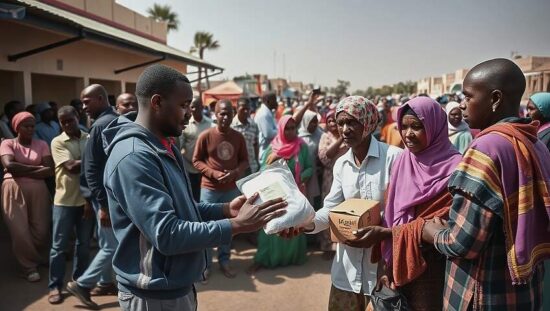
Germany’s Foreign Minister, Johann Wadephul (CDU), announced plans to increase humanitarian aid for the civilian population in Sudan. During a meeting in Berlin, he stated that they would raise their contribution by over 230 million euros. He also emphasized that other international actors must meet their humanitarian responsibilities. Wadephul noted it was a positive sign that the conference participants had already pledged over 1.3 billion euros in support, especially given the global trend of shrinking humanitarian resources.
Previously, humanitarian funding for Sudan had fallen significantly short of what was needed. For the year 2025, the United Nations’ aid plan was only 35 percent funded, and the projected need for 2026 is estimated at $2.8 billion.
Furthermore, Wadephul pledged to keep the Sudan crisis on the agenda of the UN Security Council. He described the situation in Sudan as one of the world’s largest man-made humanitarian catastrophes. The Foreign Minister stated that the death toll since 2023 is likely in the hundreds of thousands, and that over 20 million people, representing half of the population, are facing acute hunger. He affirmed that the international community would intensify peace efforts, work to stop the violence as quickly as possible, ensure humanitarian aid delivery, and achieve a ceasefire.
According to the UN Refugee Agency (UNHCR), since the conflict began between the Sudanese Armed Forces (SAF) and the paramilitary Rapid Support Forces (RSF) in April 2023, approximately 14 million people-a quarter of the country’s population-have been displaced. Of these, 9 million remain internally displaced within Sudan; 4.4 million have fled the country, mainly settling in Chad, South Sudan, and Egypt. According to the FAO, 21 million Sudanese people are currently affected by acute food insecurity, with 6.3 million in particularly precarious conditions. Over the three years of war, the WHO has documented more than 200 attacks on health facilities, resulting in over 2,052 deaths. Additionally, a UN report concluded in February that there were signs of genocide in Al-Fashir, where the UN Coordinator for Humanitarian Assistance in Sudan, Denise Brown, reported at least 6,000 people were murdered within three days.