




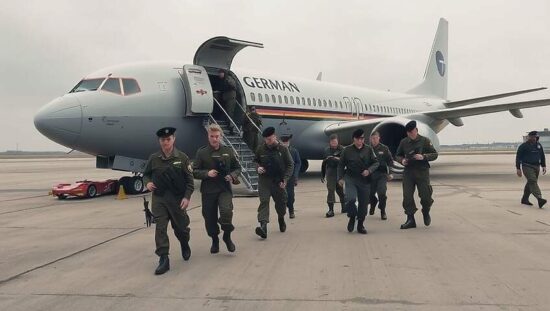
A scheduled reconnaissance mission to Greenland involving thirteen German Bundeswehr personnel has been delayed, raising questions about coordination and strategic signaling within the NATO alliance. Originally slated for a direct flight from Germany via Airbus A400M transport aircraft, the mission will now commence on Friday, with the troops first transiting to Karup, Denmark, before joining a joint Danish-led exploration team and other partners. The onward journey to Greenland will be facilitated by a civilian Danish aircraft, the type of which remains unspecified by the Ministry of Defense.
The postponement has fueled speculation, particularly given the initial plan for a direct German military flight. While the Ministry framed the shift to a coordinated approach as a “strong signal of our unity” critics are questioning the necessity of the delay itself and whether it reflects a more complex strategic calculus.
Defense Minister Boris Pistorius has preemptively sought to downplay any perception of the maneuver as directed against the United States, emphasizing the broader geopolitical context driving the increased NATO presence in the Arctic. Pistorius asserted that Russia and China’s increasing militarization of the Arctic region poses a threat to vital transportation, communication and trade routes, necessitating a robust NATO response to uphold the rules-based international order. He stressed the importance of close coordination with US partners during the Greenland reconnaissance, underscoring its execution under Danish leadership within the framework of NATO.
However, the episode highlights underlying tensions surrounding the level of independent German military action and the delicate balance of transatlantic relations. The uncertainty surrounding the aircraft used and the rationale for the delayed deployment leave room for interpretation, raising concerns about potential miscommunication and the evolving power dynamics within the alliance as NATO seeks to counter Russia and China’s ambitions in the Arctic. Analysts suggest the incident exposes a need for greater transparency and clearer communication channels between Berlin and Washington regarding military operations, especially those taking place within sensitive geopolitical zones.